


Page 31 - Complete Birds of Britain and Europe (DK - RSPB)
P. 31
WESTERN PALEARCTIC

        DISTRIBUTION
        Various distribution patterns occur in the
        region. Birds such as the Kestrel breed  Svalbard
        across Europe,Africa, and Asia. Others,
        such as the Long-eared Owl, breed in
        North America, Europe, and Asia.
        Species found across Europe and  Iceland
        Asia are labelled “Palearctic”,
        while the Robin is solely
                                      Faroe
        “European”, and the Dartford  Islands       Finland
        Warbler “Mediterranean”.              Norway         Russian
                                                             Federation
                                                Sweden  Estonia
                                   Republic  United  Denmark  Latvia
                                   of Ireland  Kingdom
                                                   Lithuania
                                           Netherlands  Belarus
                        Azores           Belgium  Germany  Poland  Kazakhstan
                                        Luxembourg  Czech Republic  Ukraine
                                        France   Slovak Republic
                                      Switzerland  Austria Hungary  Moldavia
                               Portugal    Slovenia  Croatia Romania
                                   Spain        Bosnia  Yugoslavia  Georgia
                                              Italy         Armenia  Azerbaijan
                      Madeira                        Bulgaria
                                               Albania
                                                      Macedonia  Turkey
                      Canary                       Greece
                      Islands  Morocco                        Syria
                                                          Cyprus
                                           Tunisia   Crete  Lebanon  Iraq
                                                            Israel
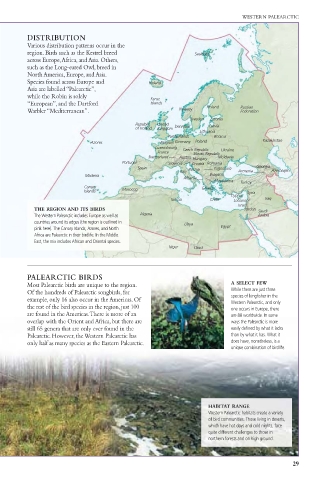
          THE REGION AND ITS BIRDS                            Jordan  Saudi
          The Western Palearctic includes Europe as well as  Algeria  Arabia
          countries around its edges (the region is outlined in
                                               Libya
          pink here). The Canary Islands, Azores, and North  Egypt
          Africa are Palearctic in their birdlife. In the Middle
          East, the mix includes African and Oriental species.
                                           Niger  Chad
        PALEARCTIC BIRDS
        Most Palearctic birds are unique to the region.   A SELECT FEW
        Of the hundreds of Palearctic songbirds, for      While there are just three
                                                          species of kingfisher in the
        example, only 16 also occur in the Americas. Of   Western Palearctic, and only
        the rest of the bird species in the region,just 100  one occurs in Europe, there
        are found in the Americas.There is more of an     are 88 worldwide. In some
        overlap with the Orient and Africa, but there are  ways the Palearctic is more
        still 65 genera that are only ever found in the   easily defined by what it lacks
        Palearctic. However, the Western Palearctic has   than by what it has. What it
        only half as many species as the Eastern Palearctic.  does have, nonetheless, is a
                                                          unique combination of birdlife.


                                                     HABITAT RANGE
                                                     Western Palearctic habitats create a variety
                                                     of bird communities. Those living in deserts,
                                                     which have hot days and cold nights, face
                                                     quite different challenges to those in
                                                     northern forests and on high ground.


                                                                          29

