


Page 40 - Complete Birds of Britain and Europe (DK - RSPB)
P. 40
INTRODUCTION

        NORTHERN MOUNTAINS AND MOORLANDS
           hese are tough habitats for wildlife, and many birds are only summer
        Tvisitors to the uplands,breeding when insects or other small birds
        are available as prey.In winter, snow and exposure to gales and rain
        make life impossible for all but a few hardy species. Some birds survive
        on a very restricted diet, in areas that offer little variety. Nevertheless,
        these are imposing and often inspiring places that do see exciting birds.
        NORTHERN MOUNTAINS
        These mountains reproduce the cold, windswept, and
        barren conditions of far northern lowlands, and so
        winter sees most birds journeying south or moving
        to lowland areas. In summer, however, these same
        habitats offer greater possibilities for migrants, as
        insect and plant life has a brief period of abundance
        and small rodents multiply quickly in the grasslands,
        providing food for predators.
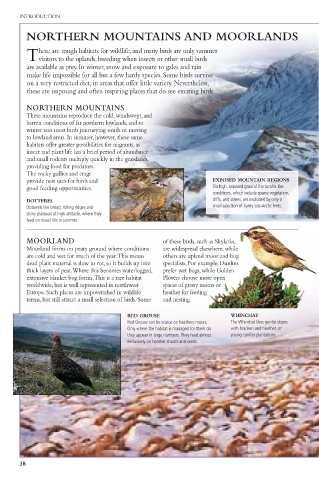
        The rocky gullies and crags
        provide nest sites for birds and              EXPOSED MOUNTAIN REGIONS
        good feeding opportunities.                   On high, exposed ground the tundra-like
                                                      conditions, which include sparse vegetation,
                                                      cliffs, and screes, are exploited by only a
        DOTTEREL
        Dotterels like broad, rolling ridges and      small selection of hardy sub-Arctic birds.
        stony plateaux at high altitude, where they
        feed on insect life in summer.
        MOORLAND                         of these birds, such as Skylarks,
        Moorland forms on peaty ground where conditions  are widespread elsewhere, while
        are cold and wet for much of the year.This means  others are upland moor and bog
        dead plant material is slow to rot, so it builds up into  specialists. For example, Dunlins
        thick layers of peat.Where this becomes waterlogged,  prefer wet bogs, while Golden
        extensive blanket bog forms.This is a rare habitat  Plovers choose more open
        worldwide, but is well represented in northwest  spaces of grassy moors or
        Europe. Such places are impoverished in wildlife  heather for feeding
        terms, but still attract a small selection of birds. Some  and nesting.

                                 RED GROUSE               WHINCHAT
                                 Red Grouse can be scarce on heathery moors.  The Whinchat likes gentle slopes
                                 Only where the habitat is managed for them do  with bracken and heather, or
                                 they appear in large numbers. They feed almost  young conifer plantations.
                                 exclusively on heather shoots and seeds.


      38

