


Page 42 - Complete Birds of Britain and Europe (DK - RSPB)
P. 42
INTRODUCTION

        SOUTHERN MOUNTAINS AND CRAGS

           he highest, harshest, snowiest peaks of southern European
        Tmountains are little different from their counterparts in the
        north, but many others are snow-free and characterized by big, bare
        crags, dizzying cliffs, and deep gorges with rushing rivers. Forests of
        beech, oak, and pine climb high on the mountain slopes, creating
        conditions that attract woodland species more characteristic of
        northern Europe.The southern influence, however, remains strong,
        with the presence of birds of prey hunting overhead, and, in the
        valleys, many other species that are not found farther north.
        HABITAT MIXTURE
        With their peaks, high pastures, and valleys, mountainous
        areas bring together a variety of habitats within a small
        area. From one spot it is possible to see riverside birds,
        woodland birds, and those characteristic of grassy pastures
        and hedgerows, as well as species that prefer cliffs and  COASTAL CLIFFS
        crags. Slightly further up the hillside, alpine species can be  Several mountain birds also
        heard or seen flying across the valleys or over the highest  breed on crags by the sea that
        peaks. Superimposed upon this natural diversity there are  offer safe nesting sites.
        regional differences. For example, some species, including
        various eagles and other birds of prey,are more easterly  BLACK WHEATEAR
        and so are found in the Balkans but not within Iberia.Birds  Warmer, south-facing stony
                                                             slopes and crags in Iberia attract
        of prey have also been wiped out of some areas due to  this eyecatching wheatear, as
        centuries of persecution,although they remain numerous  well as Black-eared Wheatears
        in Spain.Some species – such as eagles,vultures,buzzards,  and Stonechats.
        and falcons – occupy different “niches”,exploiting
        particular foods and nest sites.This may allow them to
        live close together without competing against each other.
        Alternatively,it may mean that species remain apart,each  CLIFFTOP THRUSH
        inhabiting an area that meets its particular requirements.  Limestone crags are the
                                            favoured haunt of the
                                            Blackbird-sized Blue Rock
                                            Thrush, which ventures
                                            anywhere from sea level
                                            to high in the mountains.


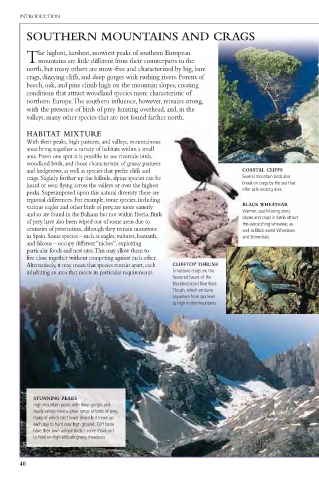
         STUNNING PEAKS
         High mountain peaks with deep gorges and
         shady valleys have a great range of birds of prey,
         many of which nest lower down but move up
         each day to hunt over high ground. Cliff faces
         have their own unique birds – some move out
         to feed on high-altitude grassy meadows.


      40

