


Page 43 - Complete Birds of Britain and Europe (DK - RSPB)
P. 43
SOUTHERN MOUNTAINS AND CRAGS


                                 WHERE TO WATCH
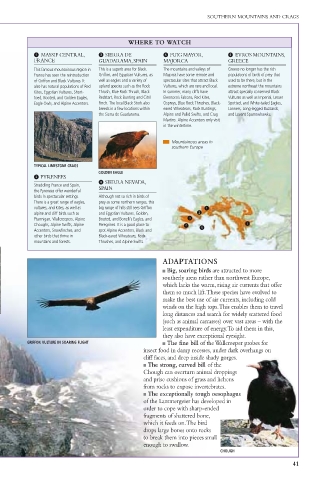
         1 MASSIF CENTRAL,  3 SIERRA DE   5 PUIG MAYOR,   6 EVROS MOUNTAINS,
         FRANCE           GUADARAMA,SPAIN   MAJORCA       GREECE
         This famous mountainous region in  This is a superb area for Black,  The mountains and valleys of  Greece no longer has the rich
         France has seen the reintroduction  Griffon, and Egyptian Vultures, as  Majorca have some remote and  populations of birds of prey that
         of Griffon and Black Vultures. It  well as eagles and a variety of  spectacular sites that attract Black  used to be there, but in the
         also has natural populations of Red  upland species such as the Rock  Vultures, which are rare and local.  extreme northeast the mountains
         Kites, Egyptian Vultures, Short-  Thrush, Blue Rock Thrush, Black  In summer, many cliffs have  attract specially conserved Black
         toed, Booted, and Golden Eagles,  Redstart, Rock Bunting and Citril  Eleonora’s Falcons, Red Kites,  Vultures as well as Imperial, Lesser
         Eagle Owls, and Alpine Accentors.  Finch. The local Black Stork also  Ospreys, Blue Rock Thrushes, Black-  Spotted, and White-tailed Eagles,
                          breeds in a few locations within   eared Wheatears, Rock Buntings,  Lanners, Long-legged Buzzards,
                          the Sierra de Guadarama.  Alpine and Pallid Swifts, and Crag  and Levant Sparrowhawks.
                                          Martins. Alpine Accentors only visit
                                          in the wintertime.
                                            Mountainous areas in
                                            southern Europe
         TYPICAL LIMESTONE CRAGS
                         GOLDEN EAGLE
         2 PYRENEES
                          4 SIERRA NEVADA,
         Straddling France and Spain,
         the Pyrenees offer wonderful   SPAIN
         birds in spectacular settings.   Although not so rich in birds of
         There is a great range of eagles,  prey as some northern ranges, this
         vultures, and Kites, as well as   big range of hills still sees Griffon  1
         alpine and cliff birds such as  and Egyptian Vultures, Golden,  2
         Ptarmigan, Wallcreepers, Alpine  Booted, and Bonelli’s Eagles, and  3
         Choughs, Alpine Swifts, Alpine  Peregrines. It is a good place to  4  6
         Accentors, Snowfinches, and   spot Alpine Accentors, Black and  5
         other birds that thrive in   Black-eared Wheatears, Rock
         mountains and forests.  Thrushes, and Alpine Swifts.
                                         ADAPTATIONS
                                          Big, soaring birds are attracted to more
                                         southerly areas rather than northwest Europe,
                                         which lacks the warm, rising air currents that offer
                                         them so much lift.These species have evolved to
                                         make the best use of air currents, including cold
                                         winds on the high tops.This enables them to travel
                                         long distances and search for widely scattered food
                                         (such as animal carcasses) over vast areas – with the
                                         least expenditure of energy.To aid them in this,
                                         they also have exceptional eyesight.
        GRIFFON VULTURE IN SOARING FLIGHT  The fine bill of the Wallcreeper probes for
                                     insect food in damp recesses, under dark overhangs on
                                     cliff faces, and deep inside shady gorges.
                                      The strong, curved bill of the
                                     Chough can overturn animal droppings
                                     and prise cushions of grass and lichens
                                     from rocks to expose invertebrates.
                                      The exceptionally tough oesophagus
                                     of the Lammergeier has developed in
                                     order to cope with sharp-ended
                                     fragments of shattered bone,
                                     which it feeds on.The bird
                                     drops large bones onto rocks
                                     to break them into pieces small
                                     enough to swallow.
                                                        CHOUGH
                                                                          41

