


Page 44 - Complete Birds of Britain and Europe (DK - RSPB)
P. 44
INTRODUCTION

        LOWLAND HEATH AND
        MEDITERRANEAN SCRUB

         n Northwest Europe lowland heath is a rare and restricted
        Ihabitat. It is often found in a thin strip along a rocky coast
        but also in special regions with sandy or acid soils, such as the
        New Forest and Brecklands in England and a few areas of
        the Netherlands and northern France. In southern Europe,
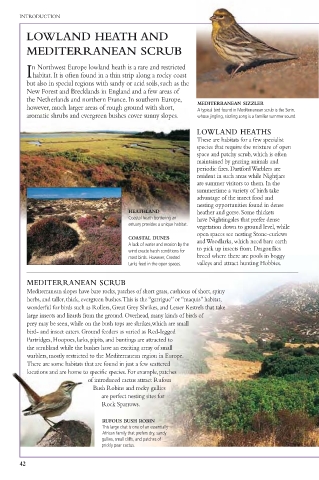
                                                  MEDITERRANEAN SIZZLER
        however, much larger areas of rough ground with short,  A typical bird found in Mediterranean scrub is the Serin,
        aromatic shrubs and evergreen bushes cover sunny slopes.  whose jingling, sizzling song is a familiar summer sound.
                                                  LOWLAND HEATHS
                                                  These are habitats for a few specialist
                                                  species that require the mixture of open
                                                  space and patchy scrub, which is often
                                                  maintained by grazing animals and
                                                  periodic fires. Dartford Warblers are
                                                  resident in such areas while Nightjars
                                                  are summer visitors to them. In the
                                                  summertime a variety of birds take
                                                  advantage of the insect food and
                                                  nesting opportunities found in dense
                                 HEATHLAND        heather and gorse. Some thickets
                                 Coastal heath bordering an  have Nightingales that prefer dense
                                 estuary provides a unique habitat.
                                                  vegetation down to ground level, while
                                                  open spaces see nesting Stone-curlews
                                 COASTAL DUNES
                                 A lack of water and erosion by the  and Woodlarks, which need bare earth
                                 wind create harsh conditions for  to pick up insects from. Dragonflies
                                 most birds. However, Crested  breed where there are pools in boggy
                                 Larks feed in the open spaces.   valleys and attract hunting Hobbies.
        MEDITERRANEAN SCRUB
        Mediterranean slopes have bare rocks, patches of short grass, cushions of short, spiny
        herbs, and taller, thick, evergreen bushes.This is the “garrigue” or “maquis” habitat,
        wonderful for birds such as Rollers, Great Grey Shrikes, and Lesser Kestrels that take
        large insects and lizards from the ground. Overhead, many kinds of birds of
        prey may be seen, while on the bush tops are shrikes,which are small
        bird- and insect eaters. Ground feeders as varied as Red-legged
        Partridges, Hoopoes, larks, pipits, and buntings are attracted to
        the scrubland while the bushes have an exciting array of small
        warblers, mostly restricted to the Mediterranean region in Europe.
        There are some habitats that are found in just a few scattered
        locations and are home to specific species. For example, patches
                       of introduced cactus attract Rufous
                        Bush Robins and rocky gullies
                          are perfect nesting sites for
                          Rock Sparrows.

                          RUFOUS BUSH ROBIN
                          This large chat is one of an essentially
                          African family that prefers dry, sandy
                          gullies, small cliffs, and patches of
                          prickly pear cactus.

      42

