


Page 45 - Complete Birds of Britain and Europe (DK - RSPB)
P. 45
LOWLAND HEATH AND MEDITERRANEAN SCRUB

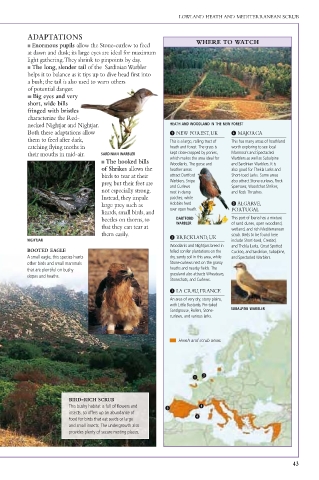
        ADAPTATIONS
         Enormous pupils allow the Stone-curlew to feed   WHERE TO WATCH
        at dawn and dusk; its large eyes are ideal for maximum
        light gathering.They shrink to pinpoints by day.
         The long, slender tail of the Sardinian Warbler
        helps it to balance as it tips up to dive head first into
        a bush; the tail is also used to warn others
        of potential danger.
         Big eyes and very
        short, wide bills
        fringed with bristles
        characterize the Red-
        necked Nightjar and Nightjar.      HEATH AND WOODLAND IN THE NEW FOREST
        Both these adaptations allow       1 NEW FOREST,UK   4 MAJORCA
        them to feed after dark,           This is a large, rolling tract of  This has many areas of heathland
        catching flying moths in           heath and forest. The grass is  worth exploring to see local
        their mouths in mid-air.  SARDINIAN WARBLER  kept close-cropped by ponies,  Marmora’s and Spectacled
                           The hooked bills   which makes the area ideal for  Warblers as well as Subalpine
                                                          and Sardinian Warblers. It is
                                           Woodlarks. The gorse and
                          of Shrikes allows the  heather areas  also good for Thekla Larks and
                          birds to tear at their  attract Dartford  Short-toed Larks. Some areas
                          prey, but their feet are  Warblers. Snipe  also attract Stone-curlews, Rock
                                                          Sparrows, Woodchat Shrikes,
                                           and Curlews
                          not especially strong.  nest in damp  and Rock Thrushes.
                          Instead, they impale  patches, while
                          large prey such as  Hobbies feed   5 ALGARVE,
                          lizards, small birds, and  over open heath.  PORTUGAL
                          beetles on thorns, so  DARTFORD  This part of Iberia has a mixture
                                             WARBLER      of sand dunes, open woodland,
                          that they can tear at           wetland, and rich Mediterranean
                          them easily.                    scrub. Birds to be found here
        NIGHTJAR                           2 BRECKLAND,UK  include Short-toed, Crested,
                                           Woodlarks and Nightjars breed in  and Thekla Larks, Great Spotted
        BOOTED EAGLE                       felled conifer plantations on the  Cuckoo, and Sardinian, Subalpine,
        A small eagle, this species hunts  dry, sandy soil in this area, while  and Spectacled Warblers.
        other birds and small mammals      Stone-curlews nest on the grassy
        that are plentiful on bushy        heaths and nearby fields. The
                                           grassland also attracts Wheatears,
        slopes and heaths.
                                           Stonechats, and Curlews.
                                           3 LA CRAU,FRANCE
                                           An area of very dry, stony plains,
                                           with Little Bustards, Pin-tailed
                                           Sandgrouse, Rollers, Stone-  SUBALPINE WARBLER
                                           curlews, and various larks.
                                             Heath and scrub areas

                                                 1  2


                  BIRD-RICH SCRUB
                  This bushy habitat is full of flowers and  3
                                          5
                  insects, so offers up an abundance of
                                                 4
                  food for birds that eat seeds or large
                  and small insects. The undergrowth also
                  provides plenty of secure nesting places.

                                                                          43

