


Page 46 - Complete Birds of Britain and Europe (DK - RSPB)
P. 46
INTRODUCTION

        FARMLAND AND GRASSLAND

           atural grassland habitats have been almost
        Neliminated from most of Europe by
        millennia of agricultural development.Those
        remaining are now rare and fragile.They host
        a collection of wildlife, including birds whose
        requirements are very specific, and which are
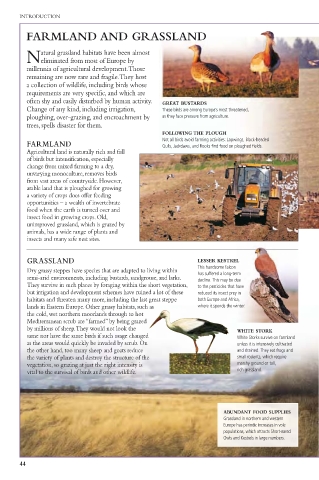
        often shy and easily disturbed by human activity.  GREAT BUSTARDS
        Change of any kind, including irrigation,  These birds are among Europe’s most threatened,
        ploughing, over-grazing, and encroachment by  as they face pressure from agriculture.
        trees, spells disaster for them.
                                         FOLLOWING THE PLOUGH
                                         Not all birds avoid farming activities: Lapwings, Black-headed
        FARMLAND                         Gulls, Jackdaws, and Rooks find food on ploughed fields.
        Agricultural land is naturally rich and full
        of birds but intensification, especially
        change from mixed farming to a dry,
        unvarying monoculture, removes birds
        from vast areas of countryside. However,
        arable land that is ploughed for growing
        a variety of crops does offer feeding
        opportunities – a wealth of invertebrate
        food when the earth is turned over and
        insect food in growing crops. Old,
        unimproved grassland, which is grazed by
        animals, has a wide range of plants and
        insects and many safe nest sites.

        GRASSLAND                                 LESSER KESTREL
                                                  This handsome falcon
        Dry grassy steppes have species that are adapted to living within  has suffered a long-term
        semi-arid environments, including bustards, sandgrouse, and larks.  decline. This may be due
        They survive in such places by foraging within the short vegetation,  to the pesticides that have
        but irrigation and development schemes have ruined a lot of these  reduced its insect prey in
        habitats and threaten many more, including the last great steppe  both Europe and Africa,
        lands in Eastern Europe. Other grassy habitats, such as  where it spends the winter.
        the cold, wet northern moorlands through to hot
        Mediterranean scrub are “farmed” by being grazed
        by millions of sheep.They would not look the        WHITE STORK
        same nor have the same birds if such usage changed  White Storks survive on farmland
        as the areas would quickly be invaded by scrub. On   unless it is intensively cultivated
        the other hand, too many sheep and goats reduce     and drained. They eat frogs and
        the variety of plants and destroy the structure of the  small rodents, which require
        vegetation, so grazing at just the right intensity is   marshy ground or tall,
        vital to the survival of birds and other wildlife.  rich grassland.


                                                         ABUNDANT FOOD SUPPLIES
                                                         Grassland in northern and western
                                                         Europe has periodic increases in vole
                                                         populations, which attracts Short-eared
                                                         Owls and Kestrels in large numbers.


      44

