


Page 47 - Complete Birds of Britain and Europe (DK - RSPB)
P. 47
FARMLAND AND GRASSLAND


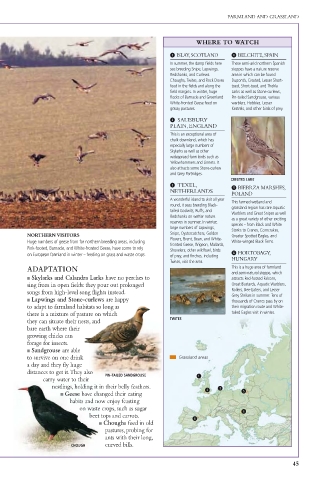
                                                  WHERE TO WATCH
                                           1 ISLAY,SCOTLAND  4 BELCHITE,SPAIN
                                           In summer, the damp fields here  These semi-arid northern Spanish
                                           see breeding Snipe, Lapwings,  steppes have a nature reserve
                                           Redshanks, and Curlews.  area in which can be found
                                           Choughs, Twites, and Rock Doves  Dupont’s, Crested, Lesser Short-
                                           feed in the fields and along the  toed, Short-toed, and Thekla
                                           field margins. In winter, huge  Larks as well as Stone-curlews,
                                           flocks of Barnacle and Greenland  Pin-tailed Sandgrouse, various
                                           White-fronted Geese feed on  warblers, Hobbies, Lesser
                                           grassy pastures.   Kestrels, and other birds of prey.
                                           2 SALISBURY
                                           PLAIN, ENGLAND
                                           This is an exceptional area of
                                           chalk downland, which has
                                           especially large numbers of
                                           Skylarks as well as other
                                           widespread farm birds such as
                                           Yellowhammers and Linnets. It
                                           also attracts some Stone-curlew
                                           and Grey Partridges.
                                                          CRESTED LARK
                                           3 TEXEL,        5 BIEBRZA MARSHES,
                                           NETHERLANDS
                                                           POLAND
                                           A wonderful island to visit all year  This farmed wetland and
                                           round, it sees breeding Black-  grassland region has rare Aquatic
                                           tailed Godwits, Ruffs, and  Warblers and Great Snipes as well
                                           Redshanks on wetter nature  as a great variety of other exciting
                                           reserves in summer. In winter,  species – from Black and White
                                           large numbers of Lapwings,  Storks to Cranes, Corncrakes,
        NORTHERN VISITORS                  Snipe, Oystercatchers, Golden  Greater Spotted Eagles, and
                                           Plovers, Brent, Bean, and White-
        Huge numbers of geese from far northern breeding areas, including  White-winged Black Terns.
                                           fronted Geese, Wigeon, Mallards,
        Pink-footed, Barnacle, and White-fronted Geese, have come to rely
                                           Shovelers, other wildfowl, birds
        on European farmland in winter – feeding on grass and waste crops.  of prey, and finches, including  6 HORTOBAGY,
                                           Twites, visit the area.  HUNGARY
        ADAPTATION                                         This is a huge area of farmland
                                                           and semi-natural steppe, which
         Skylarks and Calandra Larks have no perches to    attracts Red-footed Falcons,
        sing from in open fields: they pour out prolonged  Great Bustards, Aquatic Warblers,
        songs from high-level song flights instead.        Rollers, Bee-Eaters, and Lesser
                                                           Grey Shrikes in summer. Tens of
         Lapwings and Stone-curlews are happy              thousands of Cranes pass by on
        to adapt to farmland habitats so long as           their migration route and White-
        there is a mixture of pasture on which             tailed Eagles visit in winter.
        they can situate their nests, and  TWITES
        bare earth where their
        growing chicks can
        forage for insects.
         Sandgrouse are able
        to survive on one drink              Grassland areas
        a day and they fly huge
        distances to get it.They also  PIN-TAILED SANDGROUSE
            carry water to their                  1
              nestlings, holding it in their belly feathers.  2  3
                 Geese have changed their eating             5
                  habits and now enjoy feasting
                     on waste crops, such as sugar           6
                       beet tops and carrots.    4
                           Choughs feed in old
                           pastures, probing for
                           ants with their long,
                   CHOUGH  curved bills.
                                                                          45

