


Page 445 - Complete Birds of Britain and Europe (DK - RSPB)
P. 445
WARBLERS AND ALLIES
       Family Sylviidae  Species Sylvia sarda  Family Sylviidae  Species Acrocephalus paludicola
       Marmora’s Warbler                  Aquatic Warbler
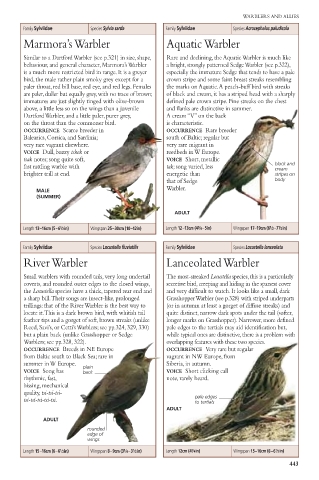
       Similar to a Dartford Warbler (see p.321) in size, shape,  Rare and declining, the Aquatic Warbler is much like
       behaviour, and general character, Marmora’s Warbler   a bright,strongly patterned Sedge Warbler (see p.322),
       is a much more restricted bird in range. It is a greyer  especially the immature Sedge that tends to have a pale
       bird, the male rather plain smoky grey except for a  crown stripe and some faint breast streaks resembling
       paler throat, red bill base, red eye, and red legs. Females  the marks on Aquatic.A peach-buff bird with streaks
       are paler,duller but equally grey,with no trace of brown;  of black and cream, it has a striped head with a sharply
       immatures are just slightly tinged with olive-brown  defined pale crown stripe. Fine streaks on the chest
       above, a little less so on the wings than a juvenile  and flanks are distinctive in summer.
       Dartford Warbler, and a little paler, purer grey,  A cream “V” on the back
       on the throat than the commoner bird.  is characteristic.
       OCCURRENCE Scarce breeder in       OCCURRENCE Rare breeder
       Balearics, Corsica, and Sardinia;  south of Baltic; regular but
       very rare vagrant elsewhere.       very rare migrant in
       VOICE Dull, buzzy tshek or         reedbeds in W Europe.
       tsak notes; song quite soft,       VOICE Short, metallic
       fast rattling warble with          tak; song varied, less     black and
                                                                     cream
       brighter trill at end.             energetic than             stripes on
                                          that of Sedge              body
                                          Warbler.
          MALE
          (SUMMER)
                                            ADULT
       Length 13–16cm (5–6 1 ⁄2in)   Wingspan 25–30cm (10–12in)  Length 12–13cm (4 3 ⁄4 –5in)   Wingspan 17–19cm (6 1 ⁄2 –7 1 ⁄2in)

       Family Sylviidae  Species Locustella fluviatilis  Family Sylviidae  Species Locustella lanceolata
       River Warbler                      Lanceolated Warbler
       Small warblers with rounded tails, very long undertail  The most-streaked Locustella species,this is a particularly
       coverts, and rounded outer edges to the closed wings,  secretive bird,creeping and hiding in the sparsest cover
       the Locustella species have a thick, tapered rear end and  and very difficult to watch. It looks like a small, dark
       a sharp bill.Their songs are insect-like, prolonged  Grasshopper Warbler (see p.328) with striped underparts
       trillings: that of the River Warbler is the best way to  (or in autumn at least a gorget of diffuse streaks) and
       locate it.This is a dark brown bird, with whitish tail  quite distinct, narrow dark spots under the tail (softer,
       feather tips and a gorget of soft, brown streaks (unlike  longer marks on Grasshopper).Narrower,more defined
       Reed, Savi’s, or Cetti’s Warblers; see pp.324, 329, 330)  pale edges to the tertials may aid identification but,
       but a plain back (unlike Grasshopper or Sedge  while typical ones are distinctive,there is a problem with
       Warblers; see pp.328, 322).        overlapping features with these two species.
       OCCURRENCE Breeds in NE Europe     OCCURRENCE Very rare but regular
       from Baltic south to Black Sea; rare in  vagrant in NW Europe, from
       summer in W Europe.                Siberia, in autumn.
                      plain
       VOICE Song has  back               VOICE Short clicking call
       rhythmic, fast,                    note, rarely heard.
       hissing, mechanical
       quality, tsi-tsi-tsi-
                                                 pale edges
       tsi-tsi-tsi-tsi-tsi.                      to tertials
                                          ADULT
            ADULT
                       rounded
                       edge of
                       wings
       Length 15–16cm (6–6 1 ⁄2in)   Wingspan 8–9cm (3 1 ⁄4 –3 1 ⁄2in)  Length 12cm (4 3 ⁄4in)  Wingspan 15–16cm (6–6 1 ⁄2in)
                                                                         443

