


Page 446 - Complete Birds of Britain and Europe (DK - RSPB)
P. 446
WARBLERS AND ALLIES
       Family Sylviidae  Species Acrocephalus dumetorum  Family Sylviidae  Species Acrocephalus agricola
       Blyth’s Reed Warbler               Paddyfield Warbler
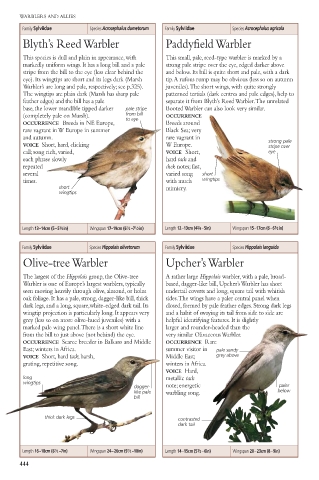
       This species is dull and plain in appearance,with  This small, pale, reed-type warbler is marked by a
       markedly uniform wings.It has a long bill and a pale  strong pale stripe over the eye, edged darker above
       stripe from the bill to the eye (less clear behind the  and below. Its bill is quite short and pale, with a dark
       eye). Its wingtips are short and its legs dark (Marsh  tip.A rufous rump may be obvious (less so on autumn
       Warbler’s are long and pale, respectively; see p.325).  juveniles).The short wings, with quite strongly
       The wingtips are plain dark (Marsh has sharp pale  patterned tertials (dark centres and pale edges), help to
       feather edges) and the bill has a pale  separate it from Blyth’s Reed Warbler.The unrelated
       base,the lower mandible tipped darker  pale stripe  Booted Warbler can also look very similar.
       (completely pale on Marsh).  from bill   OCCURRENCE
                                to eye
       OCCURRENCE Breeds in NE Europe,    Breeds around
       rare vagrant in W Europe in summer  Black Sea; very
       and autumn.                        rare vagrant in           strong pale
       VOICE Short, hard, clicking        W Europe.                 stripe over
       call; song rich, varied,           VOICE Short,              eye
       each phrase slowly                 hard tack and
       repeated                           chek notes; fast,
       several                            varied song  short
       times.                             with much  wingtips
                short                     mimicry.
                wingtips


       Length 13–14cm (5–5 1 ⁄2in)  Wingspan 17–19cm (6 1 ⁄2 –7 1 ⁄2in)  Length 12–13cm (4 3 ⁄4 –5in)  Wingspan 15–17cm (6–6 1 ⁄2in)

       Family Sylviidae  Species Hippolais olivetorum  Family Sylviidae  Species Hippolais languida
       Olive-tree Warbler                 Upcher’s Warbler
       The largest of the Hippolais group, the Olive-tree  A rather large Hippolais warbler, with a pale, broad-
       Warbler is one of Europe’s largest warblers, typically  based, dagger-like bill, Upcher’s Warbler has short
       seen moving heavily through olive, almond, or holm  undertail coverts and long, square tail with whitish
       oak foliage. It has a pale, strong, dagger-like bill, thick  sides.The wings have a paler central panel when
       dark legs, and a long, square,white-edged dark tail. Its  closed, formed by pale feather edges. Strong dark legs
       wingtip projection is particularly long. It appears very  and a habit of swaying its tail from side to side are
       grey (less so on more olive-hued juveniles) with a  helpful identifying features. It is slightly
       marked pale wing panel.There is a short white line  larger and rounder-headed than the
       from the bill to just above (not behind) the eye.  very similar Olivaceous Warbler.
       OCCURRENCE Scarce breeder in Balkans and Middle  OCCURRENCE Rare
       East; winters in Africa.           summer visitor in  pale sandy
       VOICE Short, hard tack; harsh,     Middle East;  grey above
       grating, repetitive song.          winters in Africa.
                                          VOICE Hard,
       long                               metallic tack
       wingtips
                                  dagger-  note; energetic            paler
                                  like pale  warbling song.           below
                                  bill
            thick dark legs                  contrasted
                                             dark tail


       Length 16–18cm (6 1 ⁄2 –7in)  Wingspan 24–26cm (9 1 ⁄2 –10in)  Length 14–15cm (5 1 ⁄2 –6in)   Wingspan 20–23cm (8–9in)
      444

