


Page 53 - Complete Birds of Britain and Europe (DK - RSPB)
P. 53
WATCHING BIRDS

                               CODE OF CONDUCT
        There is one simple rule for birdwatchers to
        follow: the welfare of the bird comes first.
        It is easy to get carried away, and to inch
        forward while trying to see a bird that you
        think might be rare or is one that you have
        not seen before. It may be tempting to chase
        a bird if it starts to move away, or to try
        flushing a bird out one last time, but all you
        will do is scare it away. Most birds are not
        bothered too much by everyday disturbance,
        but use your common sense. Don’t disturb
        birds while they are at their nests, as you may
        put them in danger, and never be tempted to
        handle eggs. Keep all types of disturbance to
        a minimum – for the sake of the birds, other
        people, and your own view.


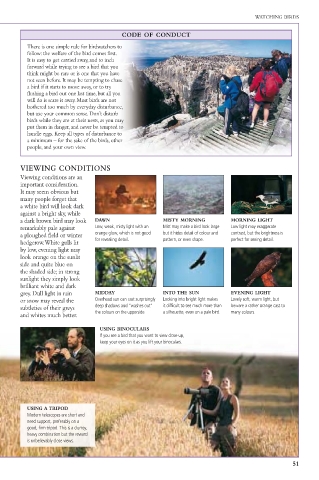
      VIEWING CONDITIONS
      Viewing conditions are an
      important consideration.
      It may seem obvious but
      many people forget that
      a white bird will look dark
      against a bright sky, while
      a dark brown bird may look  DAWN    MISTY MORNING   MORNING LIGHT
      remarkably pale against   Low, weak, misty light with an  Mist may make a bird look large  Low light may exaggerate
                         orange glow, which is not good  but it hides detail of colour and  contrast, but the brightness is
      a ploughed field or winter
                         for revealing detail.  pattern, or even shape.   perfect for seeing detail.
      hedgerow.White gulls lit
      by low, evening light may
      look orange on the sunlit
      side and quite blue on
      the shaded side; in strong
      sunlight they simply look
      brilliant white and dark
      grey. Dull light in rain   MIDDAY   INTO THE SUN    EVENING LIGHT
      or snow may reveal the  Overhead sun can cast surprisingly  Looking into bright light makes   Lovely soft, warm light, but
                         deep shadows and “washes out”  it difficult to see much more than  beware a rather orange cast to
      subtleties of their greys
                         the colours on the upperside.   a silhouette, even on a pale bird.  many colours.
      and whites much better.
                          USING BINOCULARS
                          If you see a bird that you want to view close-up,
                          keep your eyes on it as you lift your binoculars.


        USING A TRIPOD
        Modern telescopes are short and
        need support, preferably on a
        good, firm tripod. This is a clumsy,
        heavy combination but the reward
        is unbelievably close views.


                                                                          51

