


Page 52 - Complete Birds of Britain and Europe (DK - RSPB)
P. 52
INTRODUCTION

        WATCHING BIRDS

           here are a vast number of opportunities to birdwatch –
        Twhether you visit a different country specifically for
        that purpose, go to a nature reserve,or simply look at the
        species that can be found every day in your garden or on
        your journey to work.You will find that there are a huge
        range of birds to see and the more you look,the more you
                                                  WINTER ROBIN
        will want to learn about the differences there are between  In winter, putting out food or leaving apples unpicked on
        them so that you can start to identify individual species.  a tree will attract Robins and thrushes to your garden.
                           BIRD BOXES  GETTING STARTED
                           Most gardens have  It can be difficult to get close enough to birds to identify
                           food but no natural  them as they tend to perch high on trees or far out on
                           nest sites for hole-  lakes. Don’t let this put you off, however, as with practice
                           nesting birds such as  and experience you will learn how to pick out unique
                           sparrows, tits, and
                           Starlings. Artificial  characteristics from afar.The better you get, the more you
                           boxes give them a  will enjoy birdwatching.To help with this process, buy
                           chance to nest where  yourself an identification guide, a pair of binoculars, and
                           you can watch them.  a notebook – a knowledgeable friend is a great asset too.

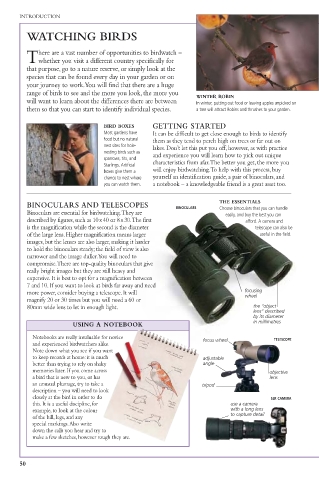
        BINOCULARS AND TELESCOPES            BINOCULARS  THE ESSENTIALS
                                                        Choose binoculars that you can handle
        Binoculars are essential for birdwatching.They are  easily, and buy the best you can
        described by figures,such as 10 x 40 or 8 x 30.The first  afford. A camera and
        is the magnification while the second is the diameter   telescope can also be
        of the large lens.Higher magnification means larger      useful in the field.
        images,but the lenses are also larger,making it harder
        to hold the binoculars steady;the field of view is also
        narrower and the image duller.You will need to
        compromise.There are top-quality binoculars that give
        really bright images but they are still heavy and
        expensive.It is best to opt for a magnification between
        7 and 10.If you want to look at birds far away and need
        more power,consider buying a telescope.It will        focusing
                                                              wheel
        magnify 20 or 30 times but you will need a 60 or
        80mm wide lens to let in enough light.                  the “object
                                                                lens” described
                                                                by its diameter
                                                                in millimetres
                   USING A NOTEBOOK
         Notebooks are really invaluable for novice   focus wheel    TELESCOPE
         and experienced birdwatchers alike.
         Note down what you see if you want
         to keep records at home: it is much       adjustable
         better than trying to rely on shaky       angle
         memories later. If you come across                         objective
         a bird that is new to you, or has                          lens
         an unusual plumage, try to take a         tripod
         description – you will need to look
         closely at the bird in order to do                         SLR CAMERA
         this. It is a useful discipline, for             use a camera
         example, to look at the colour                   with a long lens
         of the bill, legs, and any                       to capture detail
         special markings.Also write
         down the calls you hear and try to
         make a few sketches, however rough they are.


      50

