


Page 48 - Complete Birds of Britain and Europe (DK - RSPB)
P. 48
INTRODUCTION

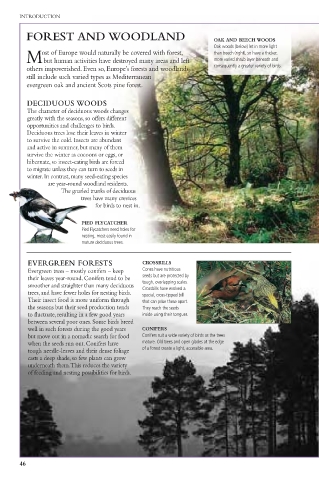
        FOREST AND WOODLAND                           OAK AND BEECH WOODS
                                                      Oak woods (below) let in more light
           ost of Europe would naturally be covered with forest,  than beech (right), so have a thicker,
        Mbut human activities have destroyed many areas and left  more varied shrub layer beneath and
                                                      consequently a greater variety of birds.
        others impoverished. Even so, Europe’s forests and woodlands
        still include such varied types as Mediterranean
        evergreen oak and ancient Scots pine forest.

        DECIDUOUS WOODS
        The character of deciduous woods changes
        greatly with the seasons, so offers different
        opportunities and challenges to birds.
        Deciduous trees lose their leaves in winter
        to survive the cold. Insects are abundant
        and active in summer, but many of them
        survive the winter as cocoons or eggs, or
        hibernate, so insect-eating birds are forced
        to migrate unless they can turn to seeds in
        winter.In contrast,many seed-eating species
             are year-round woodland residents.
                The gnarled trunks of deciduous
                     trees have many crevices
                         for birds to nest in.

                     PIED FLYCATCHER
                     Pied Flycatchers need holes for
                     nesting, most easily found in
                     mature deciduous trees.

        EVERGREEN FORESTS           CROSSBILLS
        Evergreen trees – mostly conifers – keep  Cones have nutritious
                                    seeds but are protected by
        their leaves year-round. Conifers tend to be
                                    tough, overlapping scales.
        smoother and straighter than many deciduous
                                    Crossbills have evolved a
        trees, and have fewer holes for nesting birds.
                                    special, cross-tipped bill
        Their insect food is more uniform through  that can prise these apart.
        the seasons but their seed production tends  They reach the seeds
        to fluctuate, resulting in a few good years  inside using their tongues.
        between several poor ones. Some birds breed
        well in such forests during the good years  CONIFERS
        but move out in a nomadic search for food  Conifers suit a wide variety of birds as the trees
        when the seeds run out. Conifers have  mature. Old trees and open glades at the edge
                                    of a forest create a light, accessible area.
        tough needle-leaves and their dense foliage
        casts a deep shade, so few plants can grow
        underneath them.This reduces the variety
        of feeding and nesting possibilities for birds.


      46

