


Page 49 - Complete Birds of Britain and Europe (DK - RSPB)
P. 49
FOREST AND WOODLAND


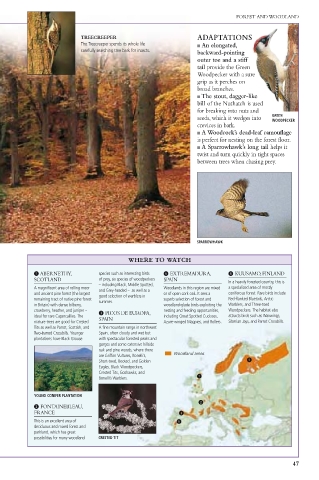
                     TREECREEPER                  ADAPTATIONS
                     The Treecreeper spends its whole life  An elongated,
                     carefully searching tree bark for insects.
                                                  backward-pointing
                                                  outer toe and a stiff
                                                  tail provide the Green
                                                  Woodpecker with a sure
                                                  grip as it perches on
                                                  broad branches.
                                                   The stout, dagger-like
                                                  bill of the Nuthatch is used
                                                  for breaking into nuts and
                                                  seeds, which it wedges into  GREEN
                                                                     WOODPECKER
                                                  crevices in bark.
                                                   A Woodcock’s dead-leaf camouflage
                                                  is perfect for nesting on the forest floor.
                                                   A Sparrowhawk’s long tail helps it
                                                  twist and turn quickly in tight spaces
                                                  between trees when chasing prey.


                                                  SPARROWHAWK

                                 WHERE TO WATCH
         1 ABERNETHY,     species such as interesting birds   4 EXTREMADURA,  5 KUUSAMO,FINLAND
         SCOTLAND         of prey, six species of woodpeckers  SPAIN  In a heavily forested country, this is
                          – including Black, Middle Spotted,
         A magnificent area of rolling moor  Woodlands in this region are mixed  a specialized area of mostly
         and ancient pine forest (the largest  and Grey-headed – as well as a  or of open cork oak. It sees a  coniferous forest. Rare birds include
         remaining tract of native pine forest  good selection of warblers in  superb selection of forest and  Red-flanked Bluetails, Arctic
         in Britain) with dense bilberry,  summer.    woodland-glade birds exploiting the  Warblers, and Three-toed
         crowberry, heather, and juniper –  nesting and feeding opportunities,  Woodpeckers. The habitat also
         ideal for rare Capercaillies. The  3 PICOS DE EUROPA,  including Great Spotted Cuckoos,  attracts birds such as Waxwings,
         mature trees are good for Crested  SPAIN   Azure-winged Magpies, and Rollers.  Siberian Jays, and Parrot Crossbills.
         Tits as well as Parrot, Scottish, and  A fine mountain range in northwest
         Two-barred Crossbills. Younger  Spain, often cloudy and wet but
         plantations have Black Grouse.  with spectacular forested peaks and
                          gorges and some extensive hillside
                          oak and pine woods, where there
                          are Griffon Vultures, Bonelli’s,  Woodland areas
                          Short-toed, Booted, and Golden      5
                          Eagles, Black Woodpeckers,
                          Crested Tits, Goshawks, and
                          Bonelli’s Warblers.     1
          YOUNG CONIFER PLANTATION
                                                  2
         2 FONTAINEBLEAU,
         FRANCE                              3
         This is an excellent area of        4
         deciduous and mixed forest and
         parkland, which has great
         possibilities for many woodland  CRESTED TIT

                                                                          47

