


Page 51 - Complete Birds of Britain and Europe (DK - RSPB)
P. 51
GARDENS, PARKS,AND TOWNS

        PRIVATE GARDENS
        Ordinary suburban and rural
        gardens are becoming increasingly
        important wildlife havens. If there
        are thick shrubberies, flowerbeds
        with freshly turned earth, patches
        of lawn, and perhaps a few garden
        ponds, a suburban area can be
        almost as rich as a piece of natural
        woodland.These small habitats offer
        a range of feeding opportunities for
        all kinds of birds, some of which live
        permanently in the gardens while others
        just visit from nearby woods and streams.
        Even the shy Kingfisher and Grey Heron
        may make an early morning raid on a goldfish
        pond. Gardens are far poorer for birds, however,
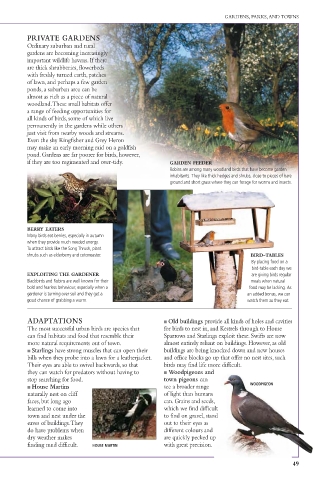
        if they are too regimented and over-tidy.  GARDEN FEEDER
                                           Robins are among many woodland birds that have become garden
                                           inhabitants. They like thick hedges and shrubs, close to pieces of bare
                                           ground and short grass where they can forage for worms and insects.


        BERRY EATERS
        Many birds eat berries, especially in autumn
        when they provide much needed energy.
        To attract birds like the Song Thrush, plant
        shrubs such as elderberry and cotoneaster.             BIRD-TABLES
                                                               By placing food on a
                                                                bird-table each day we
        EXPLOITING THE GARDENER                                are giving birds regular
        Blackbirds and Robins are well known for their         meals when natural
        bold and fearless behaviour, especially when a         food may be lacking. As
        gardener is turning over soil and they get a          an added bonus, we can
        good chance of grabbing a worm.                       watch them as they eat.

        ADAPTATIONS                        Old buildings provide all kinds of holes and cavities
        The most successful urban birds are species that   for birds to nest in, and Kestrels through to House
        can find habitats and food that resemble their   Sparrows and Starlings exploit these. Swifts are now
        more natural requirements out of town.  almost entirely reliant on buildings. However, as old
         Starlings have strong muscles that can open their  buildings are being knocked down and new houses
        bills when they probe into a lawn for a leatherjacket.  and office blocks go up that offer no nest sites, such
        Their eyes are able to swivel backwards, so that   birds may find life more difficult.
        they can watch for predators without having to   Woodpigeons and
        stop searching for food.          town pigeons can
         House Martins                    see a broader range   WOODPIGEON
        naturally nest on cliff           of light than humans
        faces, but long ago               can. Grains and seeds,
        learned to come into              which we find difficult
        town and nest under the           to find on gravel, stand
        eaves of buildings.They           out to their eyes as
        do have problems when             different colours and
        dry weather makes                 are quickly pecked up
        finding mud difficult.  HOUSE MARTIN  with great precision.


                                                                          49

