


Page 50 - Complete Birds of Britain and Europe (DK - RSPB)
P. 50
INTRODUCTION

        GARDENS, PARKS, AND TOWNS

           ardens vary greatly according to their   is a lifeline to huge numbers of birds – and not
        Glocation: some are little more than enclosed just in winter. Spring is an important period
        pieces of Mediterranean scrub while others  when birds are trying to build up energy levels
        represent woodland habitats in miniature. Urban  to begin nesting but many natural foods are
        gardens bring birds right into cities and tend to  running short.Town parks provide
        have a selection (though limited) of woodland  birds with shrubberies, lawns,
        birds but lack most of the bigger, shyer, or more  and mature trees, while a park
        demanding species.Artificial food in gardens   lake will attract wetland species.

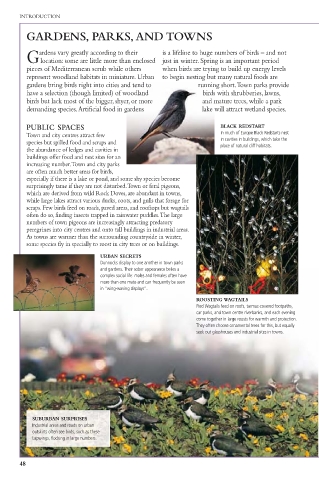
        PUBLIC SPACES                                   BLACK REDSTART
        Town and city centres attract few               In much of Europe Black Redstarts nest
        species but spilled food and scraps and         in cavities in buildings, which take the
                                                        place of natural cliff habitats.
        the abundance of ledges and cavities in
        buildings offer food and nest sites for an
        increasing number.Town and city parks
        are often much better areas for birds,
        especially if there is a lake or pond, and some shy species become
        surprisingly tame if they are not disturbed.Town or feral pigeons,
        which are derived from wild Rock Doves, are abundant in towns,
        while large lakes attract various ducks, coots, and gulls that forage for
        scraps. Few birds feed on roads, paved areas, and rooftops but wagtails
        often do so, finding insects trapped in rainwater puddles.The large
        numbers of town pigeons are increasingly attracting predatory
        peregrines into city centres and onto tall buildings in industrial areas.
        As towns are warmer than the surrounding countryside in winter,
        some species fly in specially to roost in city trees or on buildings.
                          URBAN SECRETS
                          Dunnocks display to one another in town parks
                          and gardens. Their sober appearance belies a
                          complex social life: males and females often have
                          more than one mate and can frequently be seen
                          in “wing-waving displays”.
                                                  ROOSTING WAGTAILS
                                                  Pied Wagtails feed on roofs, tarmac-covered footpaths,
                                                  car parks, and town centre riverbanks, and each evening
                                                  come together in large roosts for warmth and protection.
                                                  They often choose ornamental trees for this, but equally
                                                  seek out glasshouses and industrial sites in towns.


         SUBURBAN SURPRISES
         Industrial areas and roads on urban
         outskirts often see birds, such as these
         Lapwings, flocking in large numbers.


      48

