


Page 85 - Complete Birds of Britain and Europe (DK - RSPB)
P. 85
BITTERNS AND HERONS
       Order Ciconiiformes    Family Ardeidae        Species Ardea purpurea
        Purple Heron                                               thin stripes
                                                                   on face
          steel-grey
          midwing     arched wings
          patch       narrow at base              long, slim,
                                                  spear-like  brown
                                                  bill    body         paler
                                                                       neck
                      reddish underwing   snaky head
                                          and neck
        ADULT
                      deep neck          dark stripes on
             IN FLIGHT  bulge            bright ginger
         large                           neck
         toes
            dark back with
            paler, buff plumes
                                       dark reddish
                                       shoulder patch
        ADULT
                                    rich tawny
                                    underparts              JUVENILE


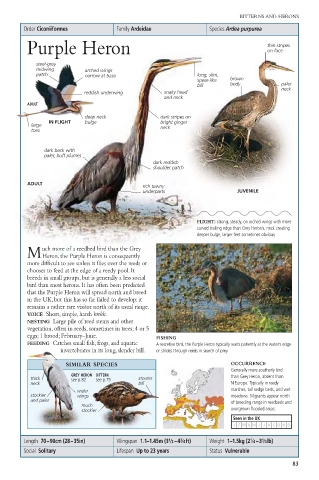
                                                  FLIGHT: strong, steady, on arched wings with more
                                                  curved trailing edge than Grey Heron’s, neck creating
                                                  deeper bulge, larger feet sometimes obvious.
           uch more of a reedbed bird than the Grey
        MHeron, the Purple Heron is consequently
        more difficult to see unless it flies over the reeds or
        chooses to feed at the edge of a reedy pool. It
        breeds in small groups, but is generally a less social
        bird than most herons. It has often been predicted
        that the Purple Heron will spread north and breed
        in the UK, but this has so far failed to develop: it
        remains a rather rare visitor north of its usual range.
        VOICE Short, simple, harsh krekk.
        NESTING Large pile of reed stems and other
        vegetation, often in reeds, sometimes in trees; 4 or 5
        eggs; 1 brood; February–June.   FISHING
        FEEDING Catches small fish, frogs, and aquatic  A secretive bird, the Purple Heron typically waits patiently at the water’s edge
                invertebrates in its long, slender bill.  or strides through reeds in search of prey.
                 SIMILAR SPECIES                          OCCURRENCE
                                                          Generally more southerly bird
                   GREY HERON BITTERN                     than Grey Heron, absent from
         thick     see p.82  see p.75  stouter
         neck                      bill                   N Europe. Typically in reedy
                    wider    much                         marshes, tall sedge beds, and wet
         stockier   wings    stockier                     meadows. Migrants appear north
         and paler                                        of breeding range in reedbeds and
                     much
                     stockier                             overgrown flooded areas.
                                                           Seen in the UK
                                                                M J JA SJ
                                                           JF M A A M  JA S O ON D
       Length  70–90cm (28–35in)  Wingspan  1.1–1.45m (3 1 ⁄2 –4 3 ⁄4ft)  Weight  1–1.5kg (2 1 ⁄4 –3 1 ⁄4lb)
       Social  Solitary       Lifespan  Up to 23 years  Status  Vulnerable
                                                                          83

