


Page 86 - Complete Birds of Britain and Europe (DK - RSPB)
P. 86
STORKS/FLAMINGOS
        Families Ciconiidae, Threskiornithidae
        STORKS

           F THE TWO SPECIES OF STORK in Europe,  Both are migrants, spending the winter far south
        Oone species, the White Stork, is able to   in Africa.White Storks migrate in huge flocks,
        live close to people, exploiting buildings and  creating exciting birdwatching as they cross the
        electricity pylons as nesting places and feeding  Mediterranean at the narrowest point, as they
        extensively on refuse tips. It is, however, under  must glide and soar to save energy and can only
        pressure from the destruction of freshwater  gain the benefit of rising air over land.Black
        habitats and the spread of intensive agriculture.  Storks may migrate alone or in smaller groups,
        The Black Stork is, in contrast, a forest bird and  but can be seen with other large migrants, such
        often nests on remote cliffs.    as eagles and kites, over the sea, or through
                                           mountain passes.They may be forced down
                                             temporarily by poor weather.


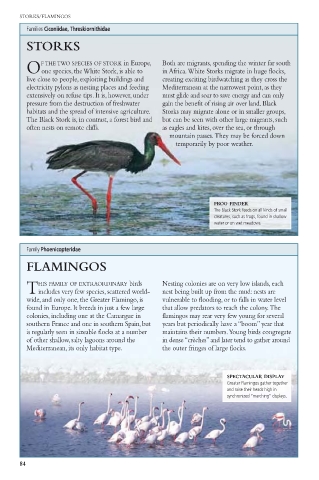
                                                      FROG FINDER
                                                      The Black Stork feeds on all kinds of small
                                                      creatures, such as frogs, found in shallow
                                                      water or on wet meadows.


        Family Phoenicopteridae
        FLAMINGOS


           HIS FAMILY OF EXTRAORDINARY birds  Nesting colonies are on very low islands, each
        Tincludes very few species, scattered world-  nest being built up from the mud: nests are
        wide, and only one, the Greater Flamingo, is  vulnerable to flooding, or to falls in water level
        found in Europe. It breeds in just a few large  that allow predators to reach the colony.The
        colonies, including one at the Camargue in  flamingos may rear very few young for several
        southern France and one in southern Spain,but  years but periodically have a “boom” year that
        is regularly seen in sizeable flocks at a number   maintains their numbers.Young birds congregate
        of other shallow, salty lagoons around the  in dense “crèches”and later tend to gather around
        Mediterranean, its only habitat type.  the outer fringes of large flocks.


                                                         SPECTACULAR DISPLAY
                                                         Greater Flamingos gather together
                                                         and raise their heads high in
                                                         synchronized “marching” displays.


      84

