


Page 140 - (DK) Smithsinian - Military History: The Definitive Visual Guide to the Objects of Warfare
P. 140
138      KEY EVENTS                 KEY DEVELOPMENT

         WDER 1500–1680  ◼ 1543  Portuguese voyagers land   CONFLICT IN EAST ASIA
              16th–17th century


              in southern Japan and introduce the
              matchlock arquebus, which is quickly
                                         In the 16th and 17th centuries, a number of large-scale wars were fought
              copied by Japanese craftsmen.
                                         throughout Japan, Korea, China, and southeast Asia. Many of these conflicts
              ◼ 1592  Korean admiral Yi Sun-sin
                                         used innovative technology, including early gunpowder weapons and
              inflicts a crushing defeat on Japanese
              naval forces at the Battle of
                                         heavily armored ironclad ships.
              Hansando, leading Japan to abandon
         AND GUNPO  its first invasion of Korea.  In Japan, the era from 1467 to 1615 is known as    prowess, which was at its peak in 1592–98,
              ◼ 1598  A second Japanese invasion
                                         the Sengoku Period, “the age of the country at
                                                                                        during which time Korean admiral  Yi Sun-sin
              of Korea fails, after fierce fighting on
                                         war,” during which powerful regional warlords,
              land, and naval defeats at Myongyang
                                                                                        won a series of battles with a fleet of cannon-
              and Noryang.
                                         the daimyo, clashed regularly. The most ambitious
                                                                                        armed, oar-powered ships—the panokseon and
                                         of them—such as Oda Nobunaga and Toyotomi
                                                                                        the iron-armored kobukson (turtle ships).
              ◼ 1600  Victory in the Battle of
                                                                                         After 1615, the Tokugawa shogunate ended
                                         Hideyoshi—aspired to unite Japan under single
              Sekigahara enables Tokugawa Ieyasu
              to take supreme power in Japan. He
         PIKES   founds the Tokugawa shogunate.  rule, a goal eventually achieved by Tokugawa Ieyasu,  Japan’s era of civil war; in China, however, the
                                         founder of the long-lived Tokugawa shogunate.
                                                                                        17th century was still a period of major conflict.
                                                                                        The Manchu, a federation of Jurchen tribes north
              ◼ c.1615  Jurchen warrior Nurhaci
              creates the Manchu Banner system,
                                         THE SAMURAI AND THE ASHIGARU
              a military organization that proves
                                         The samurai warriors of the warlords’ armies
              highly effective against the Chinese.
                                         were shifting away from their origins as mounted
              ◼ 1644  Allowed passage through   archers, in favor of fighting on foot, using spears
              the Great Wall by a renegade
              Chinese general, the Manchu occupy   and swords. Their main sword was the two-handed
              Beijing and establish the Qing dynasty.  katana, worn blade-upward so that a samurai could
                                         draw it and deliver a cut in a single, sweeping
              ◼ 1673–83  Emperor Kangxi of
              China defeats rebel warlords in the   movement. Although individual samurai became
              War of the Three Feudatories, and   legendary for their fighting prowess, the peasant
              against Ming loyalists on Taiwan.
                                         foot soldiers, the ashigaru, were also a notable force.
                                         After earlier experiments with Chinese firearms,
                                         from the 1540s onward, the ashigaru adopted
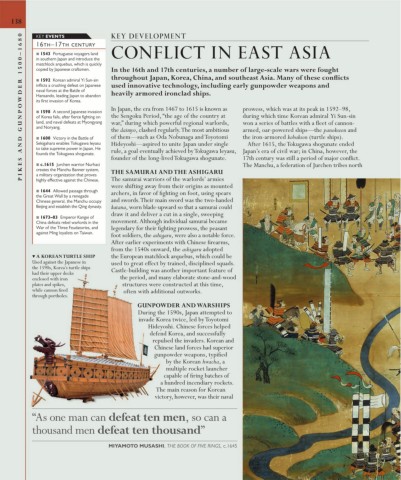
            ▼ A KOREAN TURTLE SHIP       the European matchlock arquebus, which could be
            Used against the Japanese in    used to great effect by trained, disciplined squads.
            the 1590s, Korea’s turtle ships    Castle-building was another important feature of
            had their upper decks
            enclosed with iron              the period, and many elaborate stone-and-wood
            plates and spikes,               structures were constructed at this time,
            while cannon fired               often with additional outworks.
            through portholes.
                                                  GUNPOWDER AND WARSHIPS
                                                  During the 1590s, Japan attempted to
                                                  invade Korea twice, led by Toyotomi
                                                      Hideyoshi. Chinese forces helped
                                                      defend Korea, and successfully
                                                       repulsed the invaders. Korean and
                                                        Chinese land forces had superior
                                                        gunpowder weapons, typified
                                                            by the Korean hwacha, a
                                                            multiple rocket launcher
                                                           capable of firing batches of
                                                          a hundred incendiary rockets.
                                                         The main reason for Korean
                                                        victory, however, was their naval


            “As one man can defeat ten men, so can a
            thousand men defeat ten thousand”


                                        MIYAMOTO MUSASHI, THE BOOK OF FIVE RINGS, c.1645

