


Page 32 - (DK Eyewitness) Travel Guide: Japan
P. 32
30 INTRODUCING JAP AN
Shinto: the Native Religion
Shinto is Japan’s oldest religion, the “way of the gods.” Its
core concept is that deities, kami, preside over all things in
nature, be they living, dead, or inanimate. There are lesser
and greater kami, worshiped at thousands of shrines (jinja)
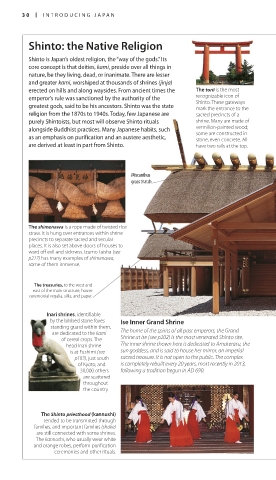
erected on hills and along waysides. From ancient times the The torii is the most
emperor’s rule was sanctioned by the authority of the recogniz able icon of
Shinto. These gateways
greatest gods, said to be his ancestors. Shinto was the state mark the entrance to the
religion from the 1870s to 1940s. Today, few Japanese are sacred precincts of a
purely Shintoists, but most will observe Shinto rituals shrine. Many are made of
alongside Buddhist practices. Many Japanese habits, such vermilion-painted wood;
some are con structed in
as an emphasis on purification and an austere aesthetic, stone, even concrete. All
are derived at least in part from Shinto. have two rails at the top.
Miscanthus
grass thatch
The shimenawa is a rope made of twisted rice
straw. It is hung over entrances within shrine
precincts to separate sacred and secular
places. It is also set above doors of houses to
ward off evil and sickness. Izumo Taisha (see
p217) has many examples of shimenawa,
some of them immense.
The treasuries, to the west and
east of the main structure, house
ceremonial regalia, silks, and paper.
Inari shrines, identifiable
by the bibbed stone foxes Ise Inner Grand Shrine
standing guard within them,
are dedica ted to the kami The home of the spirits of all past emperors, the Grand
of cereal crops. The Shrine at Ise (see p202) is the most venerated Shinto site.
head Inari shrine The inner shrine shown here is dedicated to Amaterasu, the
is at Fushimi (see sun goddess, and is said to house her mirror, an imperial
p183), just south sacred treasure. It is not open to the public. The complex
of Kyoto, and is completely rebuilt every 20 years, most recently in 2013,
30,000 others following a tradition begun in AD 690.
are scattered
throughout
the country.
The Shinto priesthood (kannushi)
tended to be transmitted through
families, and important families (shake)
are still connected with some shrines.
The kannushi, who usually wear white
and orange robes, perform purifica tion
ceremonies and other rituals.
030-031_EW_Japan.indd 30 08/08/16 3:05 pm
Eyewitness Travel LAYERS PRINTED:
Feature template “UK” LAYER
(SourceReport v1.3)
Date 18th October 2012
Size 125mm x 217mm

