


Page 37 - (DK Eyewitness) Travel Guide: Japan
P. 37
A POR TR AIT OF JAP AN 35
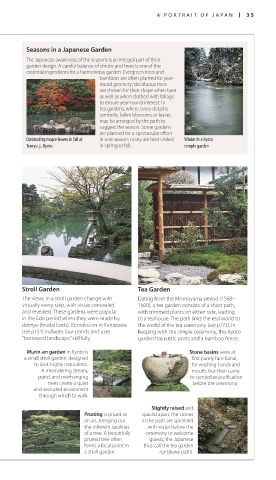
Seasons in a Japanese Garden
The Japanese awareness of the seasons is an integral part of their
garden design. A careful balance of shrubs and trees is one of the
essential ingredients for a harmonious garden. Evergreen trees and
bamboos are often planted for year-
round greenery; deciduous trees
are chosen for their shape when bare
as well as when clothed with foliage
to ensure year-round interest. In
tea gardens, where every detail is
symbolic, fallen blossoms or leaves
may be arranged by the path to
suggest the season. Some gardens
are planned for a spectac ular effect
Contrasting maple leaves in fall at in one season; many are best visited Winter in a Kyoto
Tenryu-ji, Kyoto in spring or fall. temple garden
Stroll Garden Tea Garden
The views in a stroll garden change with Dating from the Momoyama period (1568–
virtually every step, with vistas concealed 1600), a tea garden consists of a short path,
and revealed. These gardens were popular with trimmed plants on either side, leading
in the Edo period when they were made by to a teahouse. The path links the real world to
daimyo (feudal lords). Kenroku-en in Kanazawa the world of the tea ceremony (see p173). In
(see p152) includes four ponds and uses keeping with the simple ceremony, this Kyoto
“borrowed landscape” skillfully. garden has rustic posts and a bamboo fence.
Murin-an garden in Kyoto is Stone basins were at
a small stroll garden, designed first purely functional,
to look highly naturalistic. for washing hands and
A meandering stream, mouth, but then came
pond, and overhanging to symbolize purification
trees create a quiet before the ceremony.
and secluded enviroment
through which to walk.
Slightly raised and
Pruning is prized as spaced apart, the stones
an art, bringing out in the path are sprinkled
the inherent qualities with water before the
of a tree. A beautifully ceremony to welcome
pruned tree often guests; the Japanese
forms a focal point in thus call the tea garden
a stroll garden. roji (dewy path).
034-035_EW_Japan.indd 35 08/08/16 3:05 pm

