


Page 34 - (DK Eyewitness) Travel Guide: Japan
P. 34
32 INTRODUCING JAP AN
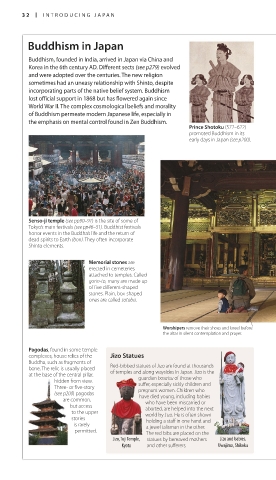
Buddhism in Japan
Buddhism, founded in India, arrived in Japan via China and
Korea in the 6th century AD. Different sects (see p279) evolved
and were adopted over the centuries. The new religion
sometimes had an uneasy relation ship with Shinto, despite
incorporating parts of the native belief system. Buddhism
lost official support in 1868 but has flowered again since
World War II. The complex cosmological beliefs and morality
of Buddhism permeate modern Japanese life, especially in
the emphasis on mental control found in Zen Buddhism.
Prince Shotoku (572–622)
promoted Buddhism in its
early days in Japan (see p200).
Senso-ji temple (see pp90–91) is the site of some of
Tokyo’s main festivals (see pp46–51). Buddhist festivals
honor events in the Buddha’s life and the return of
dead spirits to Earth (bon). They often incorporate
Shinto elements.
Memorial stones are
erected in cemeteries
attached to temples. Called
gorin-to, many are made up
of five different-shaped
stones. Plain, box-shaped
ones are called sotoba.
Worshipers remove their shoes and kneel be fore
the altar in silent contemplation and prayer.
Pagodas, found in some tem ple
complexes, house relics of the Jizo Statues
Buddha, such as fragments of
bone. The relic is usually placed Red-bibbed statues of Jizo are found at thou sands
at the base of the central pillar, of temples and along waysides in Japan. Jizo is the
hidden from view. guardian bosat su of those who
Three- or five-story suffer, especially sickly children and
pregnant women. Children who
(see p200) pago das have died young, including babies
are common, who have been miscarried or
but access aborted, are helped into the next
to the upper world by Jizo. He is often shown
stories holding a staff in one hand and
is rarely a jewel talisman in the other.
permitted. The red bibs are placed on the
Jizo, Toji Temple, statues by bereaved moth ers Jizo and babies,
Kyoto and other sufferers. Uwajima, Shikoku
032-033_EW_Japan.indd 32 08/08/16 3:05 pm
Eyewitness Travel LAYERS PRINTED:
Feature template “UK” LAYER
(SourceReport v1.3)
Date 18th October 2012
Size 125mm x 217mm

