


Page 36 - (DK Eyewitness) Travel Guide: Japan
P. 36
34 INTRODUCING JAP AN
Japanese Gardens
Originating around early Shinto shrines, Japanese gardens
have been influenced by the Shinto love of nature and the
Buddhist ideal of paradise. Although classic Japanese
gardens can be roughly divided into four types – paradise
gardens, dry-landscape gardens, stroll gardens, and tea
gardens – they share many components and principles,
and have continued evolving through the centuries. The Modern gardens in Japan have
common aim was to create a microcosm: stones, water, altered as architectural styles
bridges, and other elements were combined to form an have changed, but many still use
idealized and symbolic miniature landscape. Paradise and traditional components, such
as water, stones, and gravel, in
dry-landscape gardens were designed to be viewed from a a less sinuous, more geometric
single point or side, while stroll gardens and tea gardens way than in the past.
were made to be walked through.
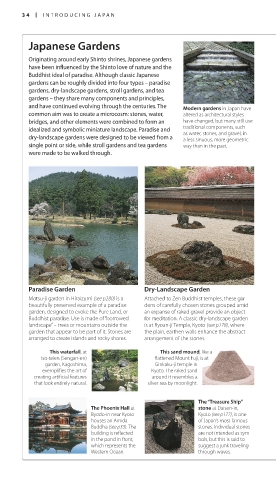
Paradise Garden Dry-Landscape Garden
Motsu-ji garden in Hiraizumi (see p280) is a Attached to Zen Buddhist temples, these gar-
beautifully preserved example of a paradise dens of carefully chosen stones grouped amid
garden, designed to evoke the Pure Land, or an expanse of raked gravel provide an object
Buddhist paradise. Use is made of “borrowed for meditation. A classic dry-landscape garden
landscape” – trees or mountains outside the is at Ryoan-ji Temple, Kyoto (see p178), where
garden that appear to be part of it. Stones are the plain, earthen walls enhance the abstract
arranged to create islands and rocky shores. arrangement of the stones.
This waterfall, at This sand mound, like a
Iso-teien (Sengan-en) flattened Mount Fuji, is at
garden, Kagoshima, Ginkaku-ji temple in
exemplifies the art of Kyoto. The raked sand
creating artificial features around it resembles a
that look entirely natural. silver sea by moonlight.
The “Treasure Ship”
The Phoenix Hall at stone at Daisen-in,
Byodo-in near Kyoto Kyoto (see p177), is one
houses an Amida of Japan’s most famous
Buddha (see p33). The stones. Individual stones
building is reflected are not intended as sym-
in the pond in front, bols, but this is said to
which represents the suggest a junk traveling
Western Ocean. through waves.
034-035_EW_Japan.indd 34 08/08/16 3:05 pm
Eyewitness Travel LAYERS PRINTED:
Feature template “UK” LAYER
(SourceReport v1.3)
Date 18th October 2012
Size 125mm x 217mm

