


Page 38 - (DK Eyewitness) Travel Guide: Japan
P. 38
36 INTRODUCING JAP AN
Traditional Japanese Houses
Known as minka or “commoners’ houses,” traditional
dwellings vary widely in their layout and appear ance
from region to region, often in response to local
weather conditions. Made largely of wood and paper,
they were designed to be adaptable in their use of the
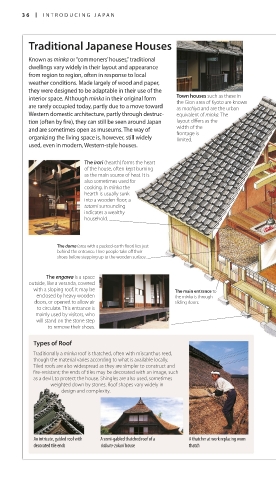
interior space. Although minka in their original form Town houses such as these in
the Gion area of Kyoto are known
are rarely occupied today, partly due to a move toward as machiya and are the urban
Western domestic architecture, partly through destruc equivalent of minka. The
tion (often by fire), they can still be seen around Japan layout differs as the
and are sometimes open as museums. The way of width of the
frontage is
organizing the living space is, however, still widely limited.
used, even in modern, Westernstyle houses.
The irori (hearth) forms the heart
of the house, often kept burning
as the main source of heat. It is
also sometimes used for
cooking. In minka the
hearth is usually sunk
into a wooden floor; a
tatami surrounding
indicates a wealthy
household.
The doma (area with a packed-earth floor) lies just
behind the entrance. Here people take off their
shoes before stepping up to the wooden surface.
The engawa is a space
outside, like a veranda, covered
with a sloping roof. It may be The main entrance to
enclosed by heavy wooden the minka is through
doors, or opened to allow air sliding doors.
to circulate. This entrance is
mainly used by visitors, who
will stand on the stone step
to remove their shoes.
Types of Roof
Traditionally a minka roof is thatched, often with miscanthus reed,
though the material varies according to what is available locally.
Tiled roofs are also widespread as they are simpler to construct and
fire-resistant; the ends of tiles may be decorated with an image, such
as a devil, to protect the house. Shingles are also used, sometimes
weighted down by stones. Roof shapes vary widely in
design and complexity.
An intricate, gabled roof with A semi-gabled thatched roof of a A thatcher at work replacing worn
decorated tile ends kabuto-zukuri house thatch
036-037_EW_Japan.indd 36 08/08/16 3:05 pm
Eyewitness Travel LAYERS PRINTED:
Feature template “UK” LAYER
(SourceReport v1.3)
Date 18th October 2012
Size 125mm x 217mm

