


Page 40 - (DK Eyewitness) Travel Guide: Japan
P. 40
38 INTRODUCING JAP AN
Sumo and the Martial Arts
Now more of a professional sport than a martial art, sumo can
trace its origins back 2,000 years to Shinto harvest rites, and
strong links with Shinto remain in many sumo rituals. There are
six sumo tournaments in Japan every year (see p350), broadcast
live on TV and followed enthusiastically. Training is a way of life
(see p106) for sumo wrestlers, and if a tournament is not on, it
may be possible to watch practice sessions (see p115). Martial
arts are known as budo, or the “martial way.” They aim to cultivate
balance, control, speed, and accuracy in a spiritual, mental, and Sumo wrestlers were a
physical sense. Kendo and kyudo, the least changed since the highly popular subject
for Edo-period
days of the samurai, are seen as the purest of the martial arts. woodblock prints.
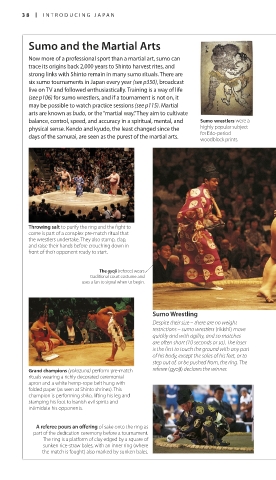
Throwing salt to purify the ring and the fight to
come is part of a complex pre-match ritual that
the wrestlers undertake. They also stamp, clap,
and raise their hands before crouching down in
front of their opponent ready to start.
The gyoji (referee) wears
traditional court costume and
uses a fan to signal when to begin.
Sumo Wrestling
Despite their size – there are no weight
restrictions – sumo wrestlers (rikishi) move
quickly and with agility, and so matches
are often short (10 seconds or so). The loser
is the first to touch the ground with any part
of his body, except the soles of his feet, or to
step out of, or be pushed from, the ring. The
Grand champions (yokozuna) perform pre-match referee (gyoji) declares the winner.
rituals wearing a richly decorated ceremonial
apron and a white hemp-rope belt hung with
folded paper (as seen at Shinto shrines). This
champion is per forming shiko, lifting his leg and
stamping his foot to banish evil spirits and
intimidate his opponents.
A referee pours an offering of sake onto the ring as
part of the dedication ceremony before a tourna ment.
The ring is a platform of clay edged by a square of
sunken rice-straw bales, with an inner ring (where
the match is fought) also marked by sunken bales.
038-039_EW_Japan.indd 38 08/08/16 2:53 pm

