


Page 208 - (DK) The Business Book
P. 208
206 THE LEARNING ORGANIZATION


        School concluded that poor       success by actively fostering the
        management practices were the    education of all employees in order
        major reason for employee turnover.   to innovate and adapt. In this
        The problem of high turnover in   respect, Japan’s Honda Motor
        lower-paid jobs is still an issue. In   Company is often cited in case
        the January 2012 edition of the   studies as a perfect example of a   There is no organizational
        Harvard Business Review, Harvard   “learning organization.”         learning without individual
        Business School professor Zeynep    In the 1980s, while professor            learning.
        Ton wrote about companies that   of business studies at Stanford         Chris Argyris,
        had found a way to invest in their   University, Richard Pascale analyzed   Donald Schön
        staff while keeping product costs   the management style of Japanese
        low: “Highly successful retail   companies, Honda in particular. He
        chains ... not only invest heavily in   concluded that “organizational
        store employees but also have the   agility” was the reason for Honda’s
        lowest prices in their industries,   success. As evidence he cited the
        solid financial performance, and   entry of the Japanese company into
        better customer service than     the US market in 1959.           department store approached the
        their competitors. They have        Honda had been preparing to   Honda team to ask if it could sell
        demonstrated that, even in the   launch its larger 250 cc and 350 cc   the smaller bikes. The sales team
        lowest-price segment of retail, bad   motorcycles in Los Angeles, but the  reported back to head office and
        jobs are not a cost-driven necessity   advance sales team soon realized   advised that instead of launching
        but a choice. And they have proven   that the big Japanese bikes were   the larger bikes, the Super Cub
        that the key to breaking the trade-  inadequate for road conditions and   should be the focus of Honda’s debut
        off is a combination of investment   the vast distances traveled in the   in the US. Instead of dismissing the
        in the work force and operational   US. The team reluctantly sent the   underlings, the managers took
        practices that benefit employees,   models back to Japan for testing.   notice and agreed to go with the
        customers, and the company.”     Meanwhile, the three Japanese    advice of the sales team. The result
                                         salespeople had been zipping     for Honda was phenomenal success
        Learning by listening            around Los Angeles on the 50 cc   in the US market. In Peter Senge’s
        Peter Senge’s theory about       Super Cub, a best seller at home    model, Honda is an example of how
        corporate learning went beyond   but considered inappropriate for    “every level of an organization
        just minimizing labor turnover. He   the power-hungry American biker.   should feel included and valued.”
        intended it to be a model by which   Nevertheless, US interest in the
        companies could maximize their   Super Cub grew and Sears         Questioning precedents
                                                                          In essence, Senge’s “learning
                                                                          organization” draws on earlier
                                                                          ideas, including those of Harvard’s
                                                                          Chris Argyris. In 1977 Argyris
                                                                          published his theory of “double
                                                                          loop learning,” showing that
                                                                          companies and their employees
                                                                          can assess and modify underlying
                                                                          ways of thinking to improve their
                                                                          capacity to learn and perform
                                                                          effectively. The following year


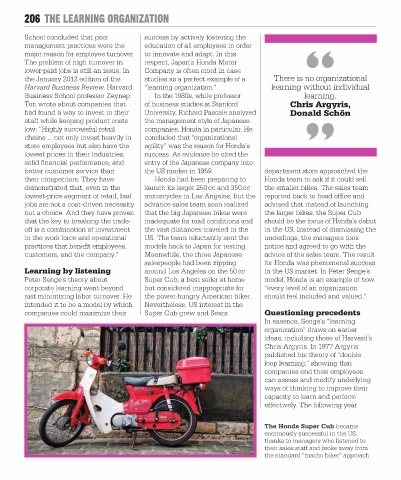
                                                                          The Honda Super Cub became
                                                                          enormously successful in the US,
                                                                          thanks to managers who listened to
                                                                          their sales staff and broke away from
                                                                          the standard “macho biker” approach.

