


Page 209 - (DK) The Business Book
P. 209
WORKING WITH A VISION        207


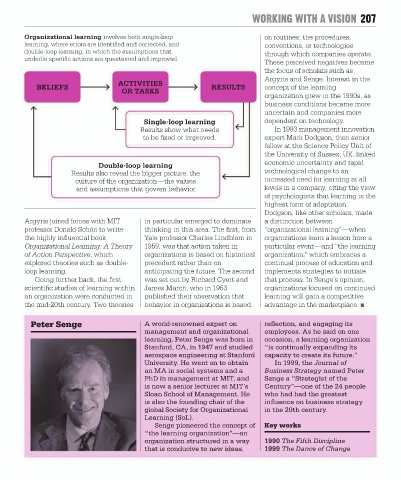
        Organizational learning involves both single-loop                 on routines: the procedures,
        learning, where errors are identified and corrected, and           conventions, or technologies
        double-loop learning, in which the assumptions that               through which companies operate.
        underlie specific actions are questioned and improved.
                                                                          These perceived negatives became
                                                                          the focus of scholars such as
                                                                          Argyris and Senge. Interest in the
                                  ACTIVITIES
           BELIEFS                                         RESULTS        concept of the learning
                                   OR TASKS
                                                                          organization grew in the 1990s, as
                                                                          business conditions became more
                                                                          uncertain and companies more
                                         Single-loop learning             dependent on technology.
                                        Results show what needs              In 1993 management innovation
                                        to be fixed or improved.           expert Mark Dodgson, then senior
                                                                          fellow at the Science Policy Unit of
                                                                          the University of Sussex, UK, linked
                                                                          economic uncertainty and rapid
                            Double-loop learning
                     Results also reveal the bigger picture: the          technological change to an
                      culture of the organization—the values              increased need for learning at all
                       and assumptions that govern behavior.              levels in a company, citing the view
                                                                          of psychologists that learning is the
                                                                          highest form of adaptation.
                                                                          Dodgson, like other scholars, made
        Argyris joined forces with MIT   in particular emerged to dominate   a distinction between
        professor Donald Schön to write    thinking in this area. The first, from  “organizational learning”—when
        the highly influential book       Yale professor Charles Lindblom in   organizations learn a lesson from a
        Organizational Learning: A Theory   1959, was that action taken in   particular event—and “the learning
        of Action Perspective, which     organizations is based on historical   organization,” which embraces a
        explored theories such as double-  precedent rather than on       continual process of education and
        loop learning.                   anticipating the future. The second   implements strategies to initiate
           Going further back, the first   was set out by Richard Cyert and   that process. In Senge’s opinion,
        scientific studies of learning within   James March, who in 1963   organizations focused on continued
        an organization were conducted in   published their observation that   learning will gain a competitive
        the mid-20th century. Two theories   behavior in organizations is based   advantage in the marketplace. ■

          Peter Senge                    A world-renowned expert on       reflection, and engaging its
                                         management and organizational    employees. As he said on one
                                         learning, Peter Senge was born in   occasion, a learning organization
                                         Stanford, CA, in 1947 and studied   “is continually expanding its
                                         aerospace engineering at Stanford   capacity to create its future.”
                                         University. He went on to obtain    In 1999, the Journal of
                                         an MA in social systems and a    Business Strategy named Peter
                                         PhD in management at MIT, and    Senge a “Strategist of the
                                         is now a senior lecturer at MIT’s   Century”—one of the 24 people
                                         Sloan School of Management. He   who had had the greatest
                                         is also the founding chair of the   influence on business strategy
                                         global Society for Organizational   in the 20th century.
                                         Learning (SoL).
                                            Senge pioneered the concept of   Key works
                                         “the learning organization”—an
                                         organization structured in a way   1990 The Fifth Discipline
                                         that is conducive to new ideas,   1999 The Dance of Change

