


Page 30 - (DK Eyewitness) Travel Guide - Estonia Latvia & Lithuania
P. 30
28       INTRODUCING  EST ONIA ,  LA T VIA  AND  LITHU ANIA


        Folk Songs and Music
        The traditional songs of Estonia, Latvia and Lithuania
        typically deal with everyday events, calendar rituals and
        rites of passage, though stories of epic heroism and
        grandeur also exist. These songs are sung by women.
        Efforts to compile the songs began in earnest in the late
        19th century and this was an important facet of the region’s
        growing national awareness. Later, bet ween 1987 and 1990,
        the struggle for freedom from the Soviet Union came to be
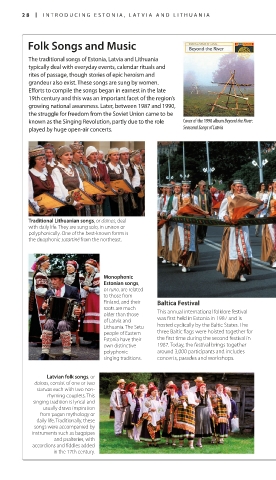
        known as the Singing Revolution, partly due to the role   Cover of the 1998 album Beyond the River:
        played by huge open-air concerts.       Seasonal Songs of Latvia


        Traditional Lithuanian songs, or dainos, deal
        with daily life. They are sung solo, in unison or
        polyphonically. One of the best-known forms is
        the duophonic sutartinė from the northeast.


                            Monophonic
                            Estonian songs,
                            or runo, are related
                            to those from
                            Finland, and their   Baltica Festival
                            roots are much
                            older than those    This annual international folklore festival
                            of Latvia and   was first held in Estonia in 1987 and is
                            Lithuania. The Setu   hosted cyclically by the Baltic States. The
                            people of Eastern   three Baltic flags were hoisted together for
                            Estonia have their   the first time during the second festival in
                            own distinctive   1987. Today, the festival brings together
                            polyphonic    around 3,000 participants and includes
                            singing tra ditions.  concerts, parades and workshops.

             Latvian folk songs, or
          dainas, consist of one or two
          stanzas each with two non-
             rhyming couplets. This
          singing tradi tion is lyrical and
            usually draws inspiration
           from pagan mythology or
          daily life. Traditionally, these
          songs were accompanied by
         instruments such as bag pipes
               and psalteries, with
         accordions and fiddles added
               in the 17th century.

