


Page 31 - (DK Eyewitness) Travel Guide - Estonia Latvia & Lithuania
P. 31
A  POR TRAIT  OF  EST ONIA ,  LA T VIA  AND  LITHU ANIA       29


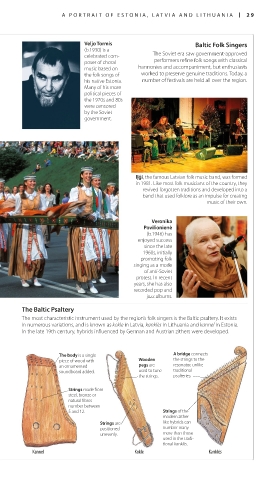
                       Veljo Tormis                Baltic Folk Singers
                       (b.1930) is a
                       celebrated com-  The Soviet era saw government-approved
                       poser of choral   performers refine folk songs with classical
                       music based on   harmonies and accompaniment, but enthusiasts
                       the folk songs of   worked to preserve genuine traditions. Today, a
                       his native Estonia.   number of festivals are held all over the region.
                       Many of his more
                       political pieces of
                       the 1970s and 80s
                       were censored
                       by the Soviet
                       government.


                                    Iļģi, the famous Latvian folk music band, was formed
                                    in 1981. Like most folk musicians of the country, they
                                      revived forgotten traditions and developed into a
                                      band that used folklore as an impulse for creating
                                                      music of their own.

                                        Veronika
                                      Povilionienė
                                       (b.1946) has
                                    enjoyed success
                                      since the late
                                      1960s, initially
                                     promoting folk
                                   singing as a mode
                                      of anti-Soviet
                                    protest. In recent
                                   years, she has also
                                   recorded pop and
                                       jazz albums.
       The Baltic Psaltery
       The most characteristic instrument used by the region’s folk singers is the Baltic psaltery. It exists
       in numerous variations, and is known as kokle in Latvia, kanklės in Lithuania and kannel in Estonia.
       In the late 19th century, hybrids influenced by German and Austrian zithers were developed.


                The body is a single          A bridge connects
                piece of wood with   Wooden   the strings to the
                an ornamented        pegs are   resonator, unlike
                soundboard added.    used to tune   traditional
                                     the strings.  psalteries.
                   Strings made from
                   steel, bronze or
                   natural fibres
                   number between
                   5 and 12.               Strings of the
                                           modern zither-
                           Strings are     like hybrids can
                           positioned      number many
                           unevenly.       more than those
                                           used in the tradi-
                                           tional kanklės.
         Kannel                     Kokle              Kanklės

