


Page 32 - (DK Eyewitness) Travel Guide - Estonia Latvia & Lithuania
P. 32
30       INTRODUCING  EST ONIA ,  LA T VIA  AND  LITHU ANIA


        Baltic Amber
        Amber has been valued for millennia, with amber jewellery
        found dating back to the early Neolithic period (around 7000 BC).
        Many medical authorities of the ancient world, including
        Hippocrates, believed that amber had healing properties. A trade
        network, now known as the Amber Road, arose at the height of
        the Roman Empire. In the medieval period, amber was used to
        make rosaries. Today, it still washes up on Latvian and Lithuanian
        shores, although 90 per cent of the world’s amber is mined in the
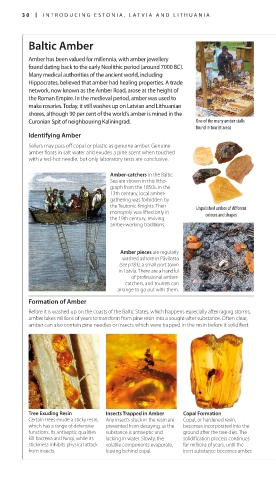
        Curonian Spit of neighbouring Kaliningrad.  One of the many amber stalls
                                                   found in tourist areas
        Identifying Amber
        Sellers may pass off copal or plastic as genuine amber. Genuine
        amber floats in salt water and exudes a pine scent when touched
        with a red-hot needle, but only laboratory tests are conclusive.

                             Amber-catchers in the Baltic
                             Sea are shown in this litho-
                             graph from the 1850s. In the
                             13th century, local amber-
                             gathering was forbidden by
                             the Teutonic Knights. Their   Unpolished amber of different
                             monopoly was lifted only in   colours and shapes
                             the 19th century, reviving
                             amber-working traditions.


                                Amber pieces are regularly
                                washed ashore in Pāvilosta
                                (see p183), a small port town
                               in Latvia. There are a handful
                                   of professional amber-
                                 catchers, and tourists can
                               arrange to go out with them.
        Formation of Amber
        Before it is washed up on the coasts of the Baltic States, which happens especially after raging storms,
        amber takes millions of years to transform from pine resin into a sought-after substance. Often clear,
        amber can also contain pine needles or insects which were trapped in the resin before it solidified.


        Tree Exuding Resin  Insects Trapped in Amber  Copal Formation
        Certain trees exude a sticky resin,   Any insects stuck in the resin are   Copal, or hardened resin,
        which has a range of def ensive   prevented from decaying, as the   becomes incorporated into the
        functions. Its antiseptic qualities   substance is antiseptic and   ground after the tree dies. The
        kill bacteria and fungi, while its   lacking in water. Slowly, the   solidification process continues
        stickiness inhi bits physical attack   volatile components evaporate,   for millions of years, until the
        from insects.       leaving behind copal.  inert substance becomes amber.

