


Page 112 - Applied Statistics with R
P. 112
112                      CHAPTER 7. SIMPLE LINEAR REGRESSION


                                 ##   2.930920   -2.933898 -18.866307   -6.798715  15.201285   16.201285  43.201285
                                 ##          50
                                 ##   4.268876

                                 fitted(stop_dist_model)


                                 ##          1         2          3         4         5          6         7          8
                                 ## -1.849460 -1.849460   9.947766   9.947766 13.880175 17.812584 21.744993 21.744993
                                 ##          9        10         11        12        13         14        15         16
                                 ## 21.744993 25.677401 25.677401 29.609810 29.609810 29.609810 29.609810 33.542219
                                 ##         17        18         19        20        21         22        23         24
                                 ## 33.542219 33.542219 33.542219 37.474628 37.474628 37.474628 37.474628 41.407036
                                 ##         25        26         27        28        29         30        31         32
                                 ## 41.407036 41.407036 45.339445 45.339445 49.271854 49.271854 49.271854 53.204263
                                 ##         33        34         35        36        37         38        39         40
                                 ## 53.204263 53.204263 53.204263 57.136672 57.136672 57.136672 61.069080 61.069080
                                 ##         41        42         43        44        45         46        47         48
                                 ## 61.069080 61.069080 61.069080 68.933898 72.866307 76.798715 76.798715 76.798715
                                 ##         49        50
                                 ## 76.798715 80.731124

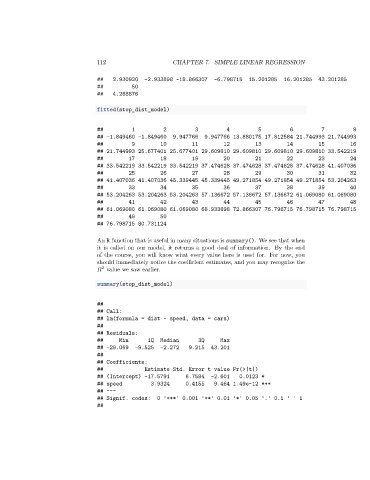
                                 An R function that is useful in many situations is summary(). We see that when
                                 it is called on our model, it returns a good deal of information. By the end
                                 of the course, you will know what every value here is used for. For now, you
                                 should immediately notice the coefficient estimates, and you may recognize the
                                   2
                                    value we saw earlier.
                                 summary(stop_dist_model)


                                 ##
                                 ## Call:
                                 ## lm(formula = dist ~ speed, data = cars)
                                 ##
                                 ## Residuals:
                                 ##     Min       1Q  Median       3Q     Max
                                 ## -29.069   -9.525  -2.272   9.215   43.201
                                 ##
                                 ## Coefficients:
                                 ##              Estimate Std. Error t value Pr(>|t|)
                                 ## (Intercept) -17.5791      6.7584   -2.601   0.0123 *
                                 ## speed          3.9324     0.4155    9.464 1.49e-12 ***
                                 ## ---
                                 ## Signif. codes:   0 '***' 0.001 '**' 0.01 '*' 0.05 '.' 0.1 ' ' 1
                                 ##

