


Page 114 - Applied Statistics with R
P. 114
114                      CHAPTER 7. SIMPLE LINEAR REGRESSION


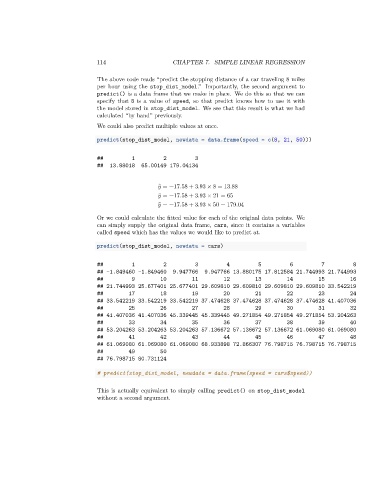
                                 The above code reads “predict the stopping distance of a car traveling 8 miles
                                 per hour using the stop_dist_model.” Importantly, the second argument to
                                 predict() is a data frame that we make in place. We do this so that we can
                                 specify that 8 is a value of speed, so that predict knows how to use it with
                                 the model stored in stop_dist_model. We see that this result is what we had
                                 calculated “by hand” previously.
                                 We could also predict multiple values at once.

                                 predict(stop_dist_model, newdata = data.frame(speed = c(8, 21, 50)))


                                 ##          1         2          3
                                 ##  13.88018   65.00149 179.04134


                                                      ̂    = −17.58 + 3.93 × 8 = 13.88
                                                      ̂    = −17.58 + 3.93 × 21 = 65
                                                      ̂    = −17.58 + 3.93 × 50 = 179.04
                                 Or we could calculate the fitted value for each of the original data points. We
                                 can simply supply the original data frame, cars, since it contains a variables
                                 called speed which has the values we would like to predict at.

                                 predict(stop_dist_model, newdata = cars)


                                 ##          1         2          3         4         5          6         7          8
                                 ## -1.849460 -1.849460   9.947766   9.947766 13.880175 17.812584 21.744993 21.744993
                                 ##          9        10         11        12        13         14        15         16
                                 ## 21.744993 25.677401 25.677401 29.609810 29.609810 29.609810 29.609810 33.542219
                                 ##         17        18         19        20        21         22        23         24
                                 ## 33.542219 33.542219 33.542219 37.474628 37.474628 37.474628 37.474628 41.407036
                                 ##         25        26         27        28        29         30        31         32
                                 ## 41.407036 41.407036 45.339445 45.339445 49.271854 49.271854 49.271854 53.204263
                                 ##         33        34         35        36        37         38        39         40
                                 ## 53.204263 53.204263 53.204263 57.136672 57.136672 57.136672 61.069080 61.069080
                                 ##         41        42         43        44        45         46        47         48
                                 ## 61.069080 61.069080 61.069080 68.933898 72.866307 76.798715 76.798715 76.798715
                                 ##         49        50
                                 ## 76.798715 80.731124

                                 # predict(stop_dist_model, newdata = data.frame(speed = cars$speed))


                                 This is actually equivalent to simply calling predict() on stop_dist_model
                                 without a second argument.

