


Page 118 - Applied Statistics with R
P. 118
118                      CHAPTER 7. SIMPLE LINEAR REGRESSION


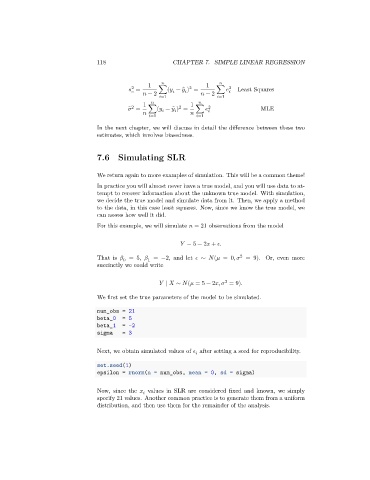
                                                  1                  1
                                            2
                                                                2
                                               =     ∑(   − ̂   ) =      ∑    2     Least Squares


                                                   − 2
                                                        =1            − 2    =1
                                                1               1
                                                            2
                                            2 ̂    =  ∑(   − ̂   ) =  ∑    2           MLE

                                                    =1              =1
                                 In the next chapter, we will discuss in detail the difference between these two
                                 estimates, which involves biasedness.
                                 7.6    Simulating SLR

                                 We return again to more examples of simulation. This will be a common theme!
                                 In practice you will almost never have a true model, and you will use data to at-
                                 tempt to recover information about the unknown true model. With simulation,
                                 we decide the true model and simulate data from it. Then, we apply a method
                                 to the data, in this case least squares. Now, since we know the true model, we
                                 can assess how well it did.
                                 For this example, we will simulate    = 21 observations from the model


                                                                = 5 − 2   +   .
                                                                                2
                                 That is    = 5,    = −2, and let    ∼   (   = 0,    = 9). Or, even more
                                                  1
                                          0
                                 succinctly we could write
                                                                           2
                                                         ∣    ∼   (   = 5 − 2  ,    = 9).
                                 We first set the true parameters of the model to be simulated.

                                 num_obs = 21
                                 beta_0   = 5
                                 beta_1   = -2
                                 sigma    = 3


                                 Next, we obtain simulated values of    after setting a seed for reproducibility.

                                 set.seed(1)
                                 epsilon = rnorm(n = num_obs, mean = 0, sd = sigma)


                                 Now, since the    values in SLR are considered fixed and known, we simply

                                 specify 21 values. Another common practice is to generate them from a uniform
                                 distribution, and then use them for the remainder of the analysis.

