


Page 160 - Applied Statistics with R
P. 160
160                   CHAPTER 9. MULTIPLE LINEAR REGRESSION


                                                                1      1    ̂    1
                                                           ⎡     ⎤  ⎡     ⎤  ⎡  ̂     ⎤
                                                           = ⎢  2 ⎥ = ⎢  2 ⎥ − ⎢  2 ⎥ .
                                                           ⎢ ⋮ ⎥   ⎢ ⋮ ⎥  ⎢ ⋮ ⎥
                                                           ⎣   ⎦   ⎣   ⎦  ⎣ ̂   ⎦


                                                                        2
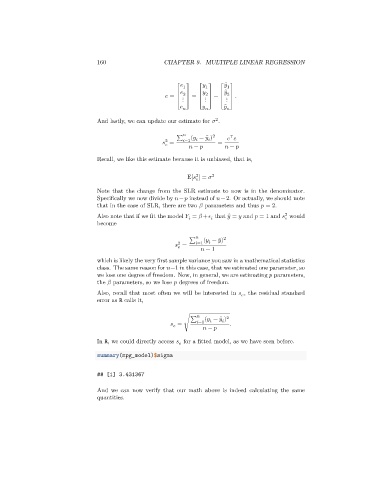
                                 And lastly, we can update our estimate for    .

                                                           ∑      (   − ̂ ) 2
                                                                             ⊤

                                                        2
                                                          =     =1    −         =     −

                                 Recall, we like this estimate because it is unbiased, that is,
                                                                  2
                                                               E[   ] =    2

                                 Note that the change from the SLR estimate to now is in the denominator.
                                 Specifically we now divide by   −   instead of   −2. Or actually, we should note
                                 that in the case of SLR, there are two    parameters and thus    = 2.
                                                                                               2

                                 Also note that if we fit the model    =    +   that ̂ = ̄ and    = 1 and    would


                                 become

                                                                ∑   (   − ̄) 2

                                                            2
                                                              =     =1

                                                                      − 1
                                 which is likely the very first sample variance you saw in a mathematical statistics
                                 class. The same reason for   −1 in this case, that we estimated one parameter, so
                                 we lose one degree of freedom. Now, in general, we are estimating    parameters,
                                 the    parameters, so we lose    degrees of freedom.
                                 Also, recall that most often we will be interested in    , the residual standard

                                 error as R calls it,

                                                                ∑     (   − ̂ ) 2

                                                            =  √    =1    −         .

                                 In R, we could directly access    for a fitted model, as we have seen before.

                                 summary(mpg_model)$sigma


                                 ## [1] 3.431367

                                 And we can now verify that our math above is indeed calculating the same
                                 quantities.

