


Page 161 - Applied Statistics with R
P. 161
9.2. SAMPLING DISTRIBUTION                                        161


                      y_hat = X %*% solve(t(X) %*% X) %*% t(X) %*% y
                      e      = y - y_hat
                      sqrt(t(e) %*% e / (n - p))


                      ##           [,1]
                      ## [1,] 3.431367

                      sqrt(sum((y - y_hat) ^ 2) / (n - p))


                      ## [1] 3.431367


                      9.2 Sampling Distribution


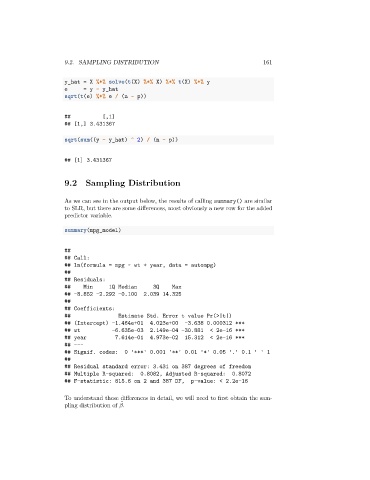
                      As we can see in the output below, the results of calling summary() are similar
                      to SLR, but there are some differences, most obviously a new row for the added
                      predictor variable.

                      summary(mpg_model)


                      ##
                      ## Call:
                      ## lm(formula = mpg ~ wt + year, data = autompg)
                      ##
                      ## Residuals:
                      ##     Min     1Q Median      3Q    Max
                      ## -8.852 -2.292 -0.100    2.039 14.325
                      ##
                      ## Coefficients:
                      ##                Estimate Std. Error t value Pr(>|t|)
                      ## (Intercept) -1.464e+01    4.023e+00  -3.638 0.000312 ***
                      ## wt           -6.635e-03   2.149e-04 -30.881  < 2e-16 ***
                      ## year          7.614e-01   4.973e-02  15.312  < 2e-16 ***
                      ## ---
                      ## Signif. codes:   0 '***' 0.001 '**' 0.01 '*' 0.05 '.' 0.1 ' ' 1
                      ##
                      ## Residual standard error: 3.431 on 387 degrees of freedom
                      ## Multiple R-squared:   0.8082, Adjusted R-squared:    0.8072
                      ## F-statistic: 815.6 on 2 and 387 DF,    p-value: < 2.2e-16


                      To understand these differences in detail, we will need to first obtain the sam-
                      pling distribution of   . ̂

