


Page 220 - Applied Statistics with R
P. 220
220 CHAPTER 11. CATEGORICAL PREDICTORS AND INTERACTIONS


                                 This looks much better! We can see that for medium displacement cars, 6
                                 cylinder cars now perform better than 8 cylinder cars, which seems much more
                                 reasonable than before.
                                 To completely justify the interaction model (i.e., a unique slope for each cyl
                                 level) compared to the additive model (single slope), we can perform an   -test.
                                 Notice first, that there is no   -test that will be able to do this since the difference
                                 between the two models is not a single parameter.
                                 We will test,


                                                               ∶    =    = 0
                                                                      3
                                                                  2
                                                              0
                                 which represents the parallel regression lines we saw before,

                                                        =    +       +       +       +   .
                                                               1
                                                                           3 3
                                                                     2 2
                                                           0
                                 Again, this is a difference of two parameters, thus no   -test will be useful.
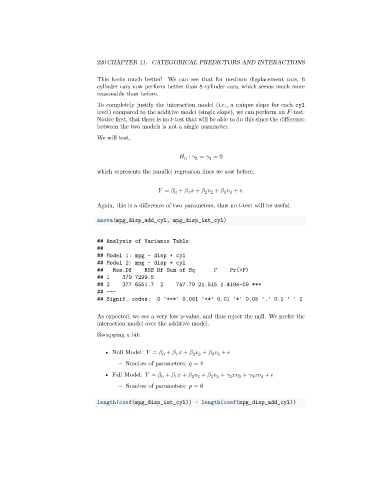
                                 anova(mpg_disp_add_cyl, mpg_disp_int_cyl)


                                 ## Analysis of Variance Table
                                 ##
                                 ## Model 1: mpg ~ disp + cyl
                                 ## Model 2: mpg ~ disp * cyl
                                 ##   Res.Df     RSS Df Sum of Sq       F    Pr(>F)
                                 ## 1     379 7299.5
                                 ## 2     377 6551.7  2    747.79 21.515 1.419e-09 ***
                                 ## ---
                                 ## Signif. codes:   0 '***' 0.001 '**' 0.01 '*' 0.05 '.' 0.1 ' ' 1


                                 As expected, we see a very low p-value, and thus reject the null. We prefer the
                                 interaction model over the additive model.
                                 Recapping a bit:


                                    • Null Model:    =    +       +       +       +
                                                                       3 3
                                                                 2 2
                                                       0
                                                           1
                                        – Number of parameters:    = 4
                                    • Full Model:    =    +       +       +       +         +         +
                                                                             2
                                                                                    3
                                                                                2
                                                                       3 3
                                                      0
                                                                                       3
                                                                2 2
                                                           1
                                        – Number of parameters:    = 6
                                 length(coef(mpg_disp_int_cyl)) - length(coef(mpg_disp_add_cyl))

