


Page 246 - Applied Statistics with R
P. 246
246                          CHAPTER 12. ANALYSIS OF VARIANCE


                                 p_vals = replicate(n = 1000, sim_anova(mu_a = -2, mu_b = 0, mu_c = 0, mu_d = 2,
                                                                        sigma = 2.0, stat = FALSE))
                                 mean(p_vals < 0.05)


                                 ## [1] 0.956

                                 mean(p_vals < 0.01)


                                 ## [1] 0.837


                                 12.4     Post Hoc Testing


                                 Suppose we reject the null hypothesis from the ANOVA test for equal means.
                                 That tells us that the means are different. But which means? All of them?
                                 Some of them? The obvious strategy is to test all possible comparisons of two
                                 means. We can do this easily in R.

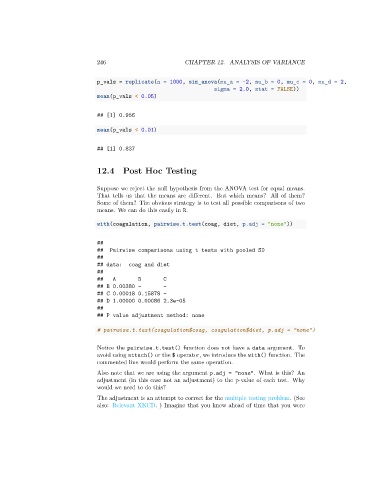
                                 with(coagulation, pairwise.t.test(coag, diet, p.adj = "none"))


                                 ##
                                 ##  Pairwise comparisons using t tests with pooled SD
                                 ##
                                 ## data:   coag and diet
                                 ##
                                 ##   A        B       C
                                 ## B 0.00380 -        -
                                 ## C 0.00018 0.15878 -
                                 ## D 1.00000 0.00086 2.3e-05
                                 ##
                                 ## P value adjustment method: none


                                 # pairwise.t.test(coagulation$coag, coagulation$diet, p.adj = "none")

                                 Notice the pairwise.t.test() function does not have a data argument. To
                                 avoid using attach() or the $ operator, we introduce the with() function. The
                                 commented line would perform the same operation.
                                 Also note that we are using the argument p.adj = "none". What is this? An
                                 adjustment (in this case not an adjustment) to the p-value of each test. Why
                                 would we need to do this?

                                 The adjustment is an attempt to correct for the multiple testing problem. (See
                                 also: Relevant XKCD. ) Imagine that you knew ahead of time that you were

