


Page 247 - Applied Statistics with R
P. 247
12.4. POST HOC TESTING                                            247


                      going to perform 100   -tests. Suppose you wish to do this with a false positive
                      rate of    = 0.05. If we use this significance level for each test, for 100 tests,
                      we then expect 5 false positives. That means, with 100 tests, we’re almost
                      guaranteed to have at least one error.
                      What we’d really like, is for the family-wise error rate to be 0.05. If we consider
                      the 100 tests to be a single “experiment” the FWER is the rate of one or more
                      false positives for in the full experiment (100 tests). Consider it an error rate
                      for an entire procedure, instead of a single test.
                      With this in mind, one of the simplest adjustments we can make, is to increase
                      the p-values for each test, depending on the number of tests. In particular the
                      Bonferroni correction simply multiplies by the number of tests.


                                        p-value-bonf = min(1,                ⋅ p-value)

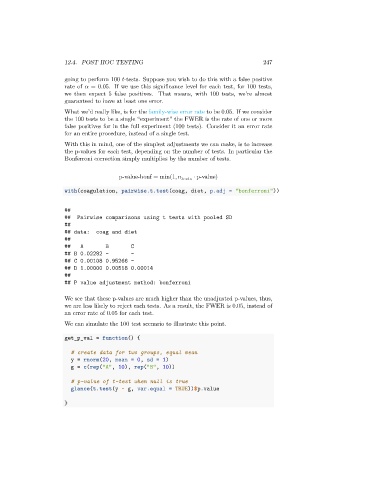
                      with(coagulation, pairwise.t.test(coag, diet, p.adj = "bonferroni"))


                      ##
                      ##   Pairwise comparisons using t tests with pooled SD
                      ##
                      ## data:   coag and diet
                      ##
                      ##    A       B       C
                      ## B 0.02282 -        -
                      ## C 0.00108 0.95266 -
                      ## D 1.00000 0.00518 0.00014
                      ##
                      ## P value adjustment method: bonferroni

                      We see that these p-values are much higher than the unadjusted p-values, thus,
                      we are less likely to reject each tests. As a result, the FWER is 0.05, instead of
                      an error rate of 0.05 for each test.
                      We can simulate the 100 test scenario to illustrate this point.

                      get_p_val = function() {

                        # create data for two groups, equal mean
                        y = rnorm(20, mean = 0, sd = 1)
                        g = c(rep("A", 10), rep("B", 10))

                        # p-value of t-test when null is true
                        glance(t.test(y ~ g, var.equal = TRUE))$p.value
                      }

