


Page 311 - Applied Statistics with R
P. 311
14.1. RESPONSE TRANSFORMATION                                     311


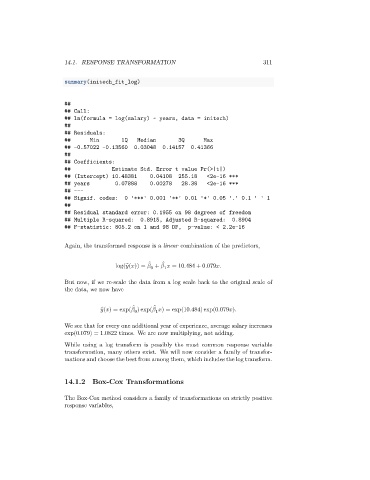
                      summary(initech_fit_log)


                      ##
                      ## Call:
                      ## lm(formula = log(salary) ~ years, data = initech)
                      ##
                      ## Residuals:
                      ##       Min       1Q   Median        3Q      Max
                      ## -0.57022 -0.13560   0.03048   0.14157  0.41366
                      ##
                      ## Coefficients:
                      ##              Estimate Std. Error t value Pr(>|t|)
                      ## (Intercept) 10.48381      0.04108  255.18   <2e-16 ***
                      ## years         0.07888     0.00278   28.38   <2e-16 ***
                      ## ---
                      ## Signif. codes:   0 '***' 0.001 '**' 0.01 '*' 0.05 '.' 0.1 ' ' 1
                      ##
                      ## Residual standard error: 0.1955 on 98 degrees of freedom
                      ## Multiple R-squared:   0.8915, Adjusted R-squared:    0.8904
                      ## F-statistic: 805.2 on 1 and 98 DF,    p-value: < 2.2e-16


                      Again, the transformed response is a linear combination of the predictors,


                                                        ̂
                                                   ̂
                                       log( ̂(  )) =    +       = 10.484 + 0.079  .

                                                   0
                                                       1
                      But now, if we re-scale the data from a log scale back to the original scale of
                      the data, we now have
                                                     ̂
                                              ̂
                                   ̂   (  ) = exp(   ) exp(     ) = exp(10.484) exp(0.079  ).
                                              0
                                                    1
                      We see that for every one additional year of experience, average salary increases
                      exp(0.079) = 1.0822 times. We are now multiplying, not adding.
                      While using a log transform is possibly the most common response variable
                      transformation, many others exist. We will now consider a family of transfor-
                      mations and choose the best from among them, which includes the log transform.


                      14.1.2    Box-Cox Transformations


                      The Box-Cox method considers a family of transformations on strictly positive
                      response variables,

