


Page 327 - Applied Statistics with R
P. 327
14.2. PREDICTOR TRANSFORMATION                                    327


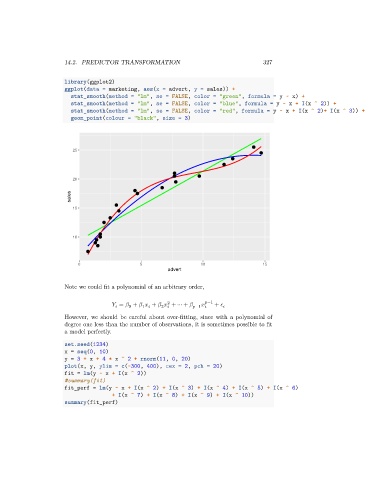
                      library(ggplot2)
                      ggplot(data = marketing, aes(x = advert, y = sales)) +
                        stat_smooth(method = "lm", se = FALSE, color = "green", formula = y ~ x) +
                        stat_smooth(method = "lm", se = FALSE, color = "blue", formula = y ~ x + I(x ^ 2)) +
                        stat_smooth(method = "lm", se = FALSE, color = "red", formula = y ~ x + I(x ^ 2)+ I(x ^ 3)) +
                        geom_point(colour = "black", size = 3)


                         25


                         20
                        sales

                         15


                         10


                           0                   5                   10                   15
                                                         advert

                      Note we could fit a polynomial of an arbitrary order,


                                                        2
                                         =    +       +       + ⋯ +      −1      −1  +

                                                      2
                                                1
                                            0

                      However, we should be careful about over-fitting, since with a polynomial of
                      degree one less than the number of observations, it is sometimes possible to fit
                      a model perfectly.
                      set.seed(1234)
                      x = seq(0, 10)
                      y = 3 + x + 4 * x ^ 2 + rnorm(11, 0, 20)
                      plot(x, y, ylim = c(-300, 400), cex = 2, pch = 20)
                      fit = lm(y ~ x + I(x ^ 2))
                      #summary(fit)
                      fit_perf = lm(y ~ x + I(x ^ 2) + I(x ^ 3) + I(x ^ 4) + I(x ^ 5) + I(x ^ 6)
                                      + I(x ^ 7) + I(x ^ 8) + I(x ^ 9) + I(x ^ 10))
                      summary(fit_perf)

