


Page 326 - Applied Statistics with R
P. 326
326                              CHAPTER 14. TRANSFORMATIONS


                                 ## ---
                                 ## Signif. codes:   0 '***' 0.001 '**' 0.01 '*' 0.05 '.' 0.1 ' ' 1
                                 ##
                                 ## Residual standard error: 0.8329 on 17 degrees of freedom
                                 ## Multiple R-squared:   0.9821, Adjusted R-squared:    0.9789
                                 ## F-statistic: 310.2 on 3 and 17 DF,    p-value: 4.892e-15

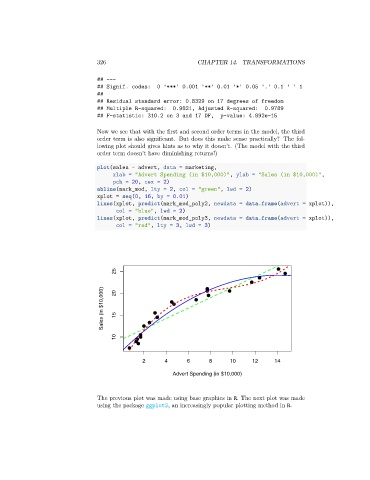
                                 Now we see that with the first and second order terms in the model, the third
                                 order term is also significant. But does this make sense practically? The fol-
                                 lowing plot should gives hints as to why it doesn’t. (The model with the third
                                 order term doesn’t have diminishing returns!)

                                 plot(sales ~ advert, data = marketing,
                                      xlab = "Advert Spending (in $10,000)", ylab = "Sales (in $10,000)",
                                      pch = 20, cex = 2)
                                 abline(mark_mod, lty = 2, col = "green", lwd = 2)
                                 xplot = seq(0, 16, by = 0.01)
                                 lines(xplot, predict(mark_mod_poly2, newdata = data.frame(advert = xplot)),
                                       col = "blue", lwd = 2)
                                 lines(xplot, predict(mark_mod_poly3, newdata = data.frame(advert = xplot)),
                                       col = "red", lty = 3, lwd = 3)


                                       25


                                   Sales (in $10,000)  20  15


                                       10


                                                2       4      6      8      10     12      14

                                                          Advert Spending (in $10,000)


                                 The previous plot was made using base graphics in R. The next plot was made
                                 using the package ggplot2, an increasingly popular plotting method in R.

