


Page 430 - Applied Statistics with R
P. 430
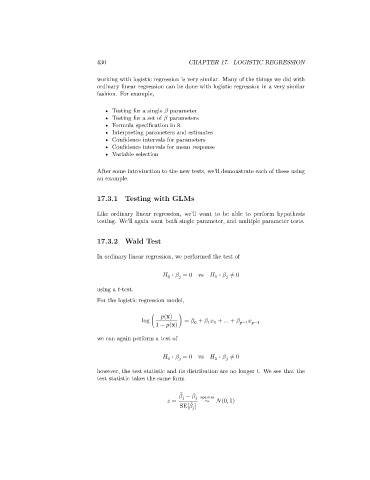
430                           CHAPTER 17. LOGISTIC REGRESSION


                                 working with logistic regression is very similar. Many of the things we did with
                                 ordinary linear regression can be done with logistic regression in a very similar
                                 fashion. For example,

                                    • Testing for a single    parameter
                                    • Testing for a set of    parameters
                                    • Formula specification in R
                                    • Interpreting parameters and estimates
                                    • Confidence intervals for parameters
                                    • Confidence intervals for mean response
                                    • Variable selection


                                 After some introduction to the new tests, we’ll demonstrate each of these using
                                 an example.


                                 17.3.1   Testing with GLMs


                                 Like ordinary linear regression, we’ll want to be able to perform hypothesis
                                 testing. We’ll again want both single parameter, and multiple parameter tests.


                                 17.3.2   Wald Test

                                 In ordinary linear regression, we performed the test of


                                                          ∶    = 0  vs    ∶    ≠ 0
                                                        0
                                                                        1


                                 using a   -test.
                                 For the logistic regression model,

                                                        (x)

                                                log (       ) =    +       + … +      −1   −1
                                                                 0
                                                                      1 1
                                                     1 −   (x)
                                 we can again perform a test of
                                                          ∶    = 0  vs    ∶    ≠ 0
                                                                        1


                                                        0
                                 however, the test statistic and its distribution are no longer   . We see that the
                                 test statistic takes the same form
                                                              ̂
                                                               −
                                                           =         approx    (0, 1)
                                                                     ∼
                                                                 ̂
                                                             SE[   ]


