


Page 428 - Applied Statistics with R
P. 428
428                           CHAPTER 17. LOGISTIC REGRESSION


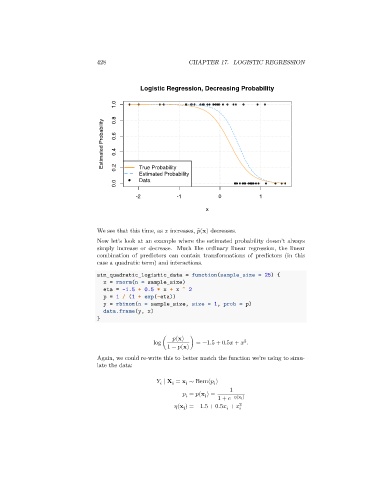
                                               Logistic Regression, Decreasing Probability

                                       1.0  0.8

                                   Estimated Probability  0.6  0.4


                                       0.2
                                               True Probability
                                               Estimated Probability
                                       0.0     Data

                                              -2            -1           0             1

                                                                     x


                                 We see that this time, as    increases, ̂(x) decreases.
                                 Now let’s look at an example where the estimated probability doesn’t always
                                 simply increase or decrease. Much like ordinary linear regression, the linear
                                 combination of predictors can contain transformations of predictors (in this
                                 case a quadratic term) and interactions.
                                 sim_quadratic_logistic_data = function(sample_size = 25) {
                                   x = rnorm(n = sample_size)
                                   eta = -1.5 + 0.5 * x + x ^ 2
                                   p = 1 / (1 + exp(-eta))
                                   y = rbinom(n = sample_size, size = 1, prob = p)
                                   data.frame(y, x)
                                 }


                                                            (x)
                                                                                  2
                                                    log (       ) = −1.5 + 0.5   +    .
                                                        1 −   (x)
                                 Again, we could re-write this to better match the function we’re using to simu-
                                 late the data:

                                                        ∣ X = x ∼ Bern(   )
                                                              i

                                                          i

                                                                             1
                                                                =   (x ) =

                                                                     i
                                                                         1 +    −  (x i )
                                                             (x ) = −1.5 + 0.5   +    2
                                                              i


