


Page 429 - Applied Statistics with R
P. 429
17.3. WORKING WITH LOGISTIC REGRESSION                            429


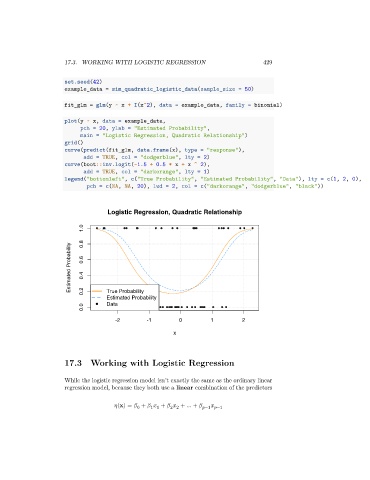
                      set.seed(42)
                      example_data = sim_quadratic_logistic_data(sample_size = 50)

                      fit_glm = glm(y ~ x + I(x^2), data = example_data, family = binomial)

                      plot(y ~ x, data = example_data,
                            pch = 20, ylab = "Estimated Probability",
                            main = "Logistic Regression, Quadratic Relationship")
                      grid()
                      curve(predict(fit_glm, data.frame(x), type = "response"),
                             add = TRUE, col = "dodgerblue", lty = 2)
                      curve(boot::inv.logit(-1.5 + 0.5 * x + x ^ 2),
                             add = TRUE, col = "darkorange", lty = 1)
                      legend("bottomleft", c("True Probability", "Estimated Probability", "Data"), lty = c(1, 2, 0),
                              pch = c(NA, NA, 20), lwd = 2, col = c("darkorange", "dodgerblue", "black"))


                                     Logistic Regression, Quadratic Relationship

                             1.0  0.8


                        Estimated Probability  0.6  0.4


                             0.2
                                    True Probability
                                    Estimated Probability
                             0.0    Data

                                       -2         -1        0          1         2
                                                          x


                      17.3     Working with Logistic Regression


                      While the logistic regression model isn’t exactly the same as the ordinary linear
                      regression model, because they both use a linear combination of the predictors


                                         (x) =    +       +       + … +      −1   −1
                                                         2 2
                                              0
                                                   1 1

