


Page 431 - Applied Statistics with R
P. 431
17.3. WORKING WITH LOGISTIC REGRESSION                            431


                      but now we are performing a   -test, as the test statistic is approximated by a
                      standard normal distribution, provided we have a large enough sample. (The
                        -test for ordinary linear regression, assuming the assumptions were correct, had
                      an exact distribution for any sample size.)
                      We’ll skip some of the exact details of the calculations, as R will obtain the
                      standard error for us. The use of this test will be extremely similar to the   -test
                      for ordinary linear regression. Essentially the only thing that changes is the
                      distribution of the test statistic.


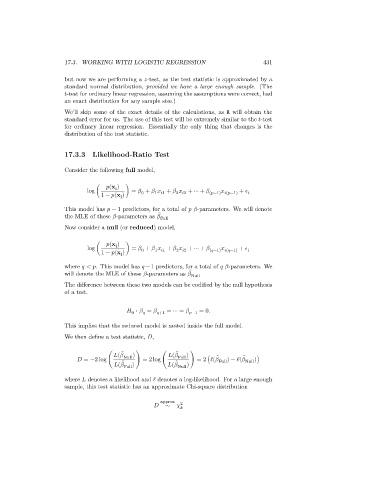
                      17.3.3    Likelihood-Ratio Test

                      Consider the following full model,


                                      (x )
                              log (    i  ) =    +       +       + ⋯ +    (  −1)   (  −1)  +

                                                    1   1
                                                0
                                                           2   2
                                  1 −   (x )
                                         i
                      This model has    − 1 predictors, for a total of      -parameters. We will denote
                                                      ̂
                      the MLE of these   -parameters as    Full
                      Now consider a null (or reduced) model,
                                      (x )
                              log (    i   ) =    +       +       + ⋯ +         +
                                  1 −   (x )    0   1   1  2   2      (  −1)   (  −1)
                                         i
                      where    <   . This model has    −1 predictors, for a total of      -parameters. We
                                                                ̂
                      will denote the MLE of these   -parameters as    Null
                      The difference between these two models can be codified by the null hypothesis
                      of a test.


                                              ∶    =      +1  = ⋯ =      −1  = 0.
                                             0

                      This implies that the reduced model is nested inside the full model.
                      We then define a test statistic,   ,


                                         (    ̂  )         (    ̂  )
                                                                          ̂
                                                                                  ̂
                              = −2 log (  Null  ) = 2 log (  Full  ) = 2 (ℓ(   Full ) − ℓ(   Null ))
                                          ̂
                                                            ̂
                                         (   Full )       (   Null )
                      where    denotes a likelihood and ℓ denotes a log-likelihood. For a large enough
                      sample, this test statistic has an approximate Chi-square distribution
                                                      approx
∼ 2 

