


Page 434 - Applied Statistics with R
P. 434
434                           CHAPTER 17. LOGISTIC REGRESSION


                                 we use the summary() function as we have done so many times before. Like the
                                   -test for ordinary linear regression, this returns the estimate of the parameter,
                                 its standard error, the relevant test statistic (  ), and its p-value. Here we have
                                 an incredibly low p-value, so we reject the null hypothesis. The ldl variable
                                 appears to be a significant predictor.
                                 When fitting logistic regression, we can use the same formula syntax as ordinary
                                 linear regression. So, to fit an additive model using all available predictors, we
                                 use:

                                 chd_mod_additive = glm(chd ~ ., data = SAheart, family = binomial)

                                 We can then use the likelihood-ratio test to compare the two models. Specifi-
                                 cally, we are testing


                                    ∶    sbp  =    tobacco  =    adiposity  =    famhist  =    typea  =    obesity  =    alcohol  =    age  = 0
                                   0
                                 We could manually calculate the test statistic,

                                 -2 * as.numeric(logLik(chd_mod_ldl) - logLik(chd_mod_additive))


                                 ## [1] 92.13879

                                 Or we could utilize the anova() function. By specifying test = "LRT", R will
                                 use the likelihood-ratio test to compare the two models.

                                 anova(chd_mod_ldl, chd_mod_additive, test = "LRT")


                                 ## Analysis of Deviance Table
                                 ##
                                 ## Model 1: chd ~ ldl
                                 ## Model 2: chd ~ sbp + tobacco + ldl + adiposity + famhist + typea + obesity +
                                 ##     alcohol + age
                                 ##   Resid. Df Resid. Dev Df Deviance    Pr(>Chi)
                                 ## 1        460     564.28
                                 ## 2        452     472.14  8    92.139 < 2.2e-16 ***
                                 ## ---
                                 ## Signif. codes:   0 '***' 0.001 '**' 0.01 '*' 0.05 '.' 0.1 ' ' 1


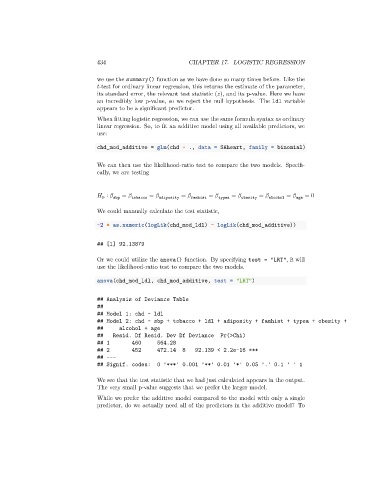
                                 We see that the test statistic that we had just calculated appears in the output.
                                 The very small p-value suggests that we prefer the larger model.

                                 While we prefer the additive model compared to the model with only a single
                                 predictor, do we actually need all of the predictors in the additive model? To

