


Page 432 - Applied Statistics with R
P. 432
432                           CHAPTER 17. LOGISTIC REGRESSION


                                 where    =    −   , the difference in number of parameters of the two models.
                                 This test, which we will call the Likelihood-Ratio Test, will be the ana-
                                 logue to the ANOVA   -test for logistic regression. Interestingly, to perform the
                                 Likelihood-Ratio Test, we’ll actually again use the anova() function in R!.
                                 The Likelihood-Ratio Test is actually a rather general test, however, here we
                                 have presented a specific application to nested logistic regression models.


                                 17.3.4   SAheart Example


                                 To illustrate the use of logistic regression, we will use the SAheart dataset from
                                 the ElemStatLearn package.

                                 # install.packages("bestglm")
                                 library(bestglm)


                                 ## Loading required package: leaps

                                 data("SAheart")

                                  sbp   tobacco   ldl  adiposity  famhist  typea  obesity  alcohol  age  chd
                                  160     12.00  5.73     23.11  Present     49    25.30   97.20   52    1
                                  144      0.01  4.41     28.61  Absent      55    28.87    2.06   63    1
                                  118      0.08  3.48     32.28  Present     52    29.14    3.81   46    0
                                  170      7.50  6.41     38.03  Present     51    31.99   24.26   58    1
                                  134     13.60  3.50     27.78  Present     60    25.99   57.34   49    1
                                  132      6.20  6.47     36.21  Present     62    30.77   14.14   45    0
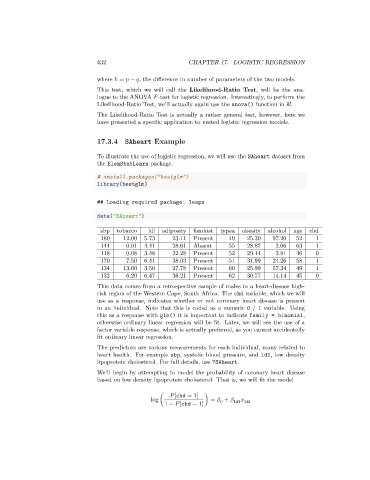
                                 This data comes from a retrospective sample of males in a heart-disease high-
                                 risk region of the Western Cape, South Africa. The chd variable, which we will
                                 use as a response, indicates whether or not coronary heart disease is present
                                 in an individual. Note that this is coded as a numeric 0 / 1 variable. Using
                                 this as a response with glm() it is important to indicate family = binomial,
                                 otherwise ordinary linear regression will be fit. Later, we will see the use of a
                                 factor variable response, which is actually preferred, as you cannot accidentally
                                 fit ordinary linear regression.
                                 The predictors are various measurements for each individual, many related to
                                 heart health. For example sbp, systolic blood pressure, and ldl, low density
                                 lipoprotein cholesterol. For full details, use ?SAheart.
                                 We’ll begin by attempting to model the probability of coronary heart disease
                                 based on low density lipoprotein cholesterol. That is, we will fit the model

                                                           [chd = 1]
                                                   log (             ) =    +
                                                       1 −   [chd = 1]    0   ldl ldl

