Page 330 - First Aid for the USMLE Step 1 2020, Thirtieth edition [MedicalBooksVN.com]_Neat
P. 330
286        SECTION III    CARDIOvASCuLAR  ``CARdIOvASCulAR—PHYSIOlOGY                                                                                          CARDIOvASCuLAR  ``CARdIOvASCulAR—PHYSIOlOGY


               Resistance, pressure,   ΔP = Q × R                              Capillaries have highest total cross-sectional
               flow                  Similar to Ohm’s law: ΔV = I × R           area and lowest flow velocity.
                                     Volumetric flow rate (Q) = flow velocity (v) ×   Pressure gradient drives flow from high pressure
                                       cross-sectional area (A)                 to low pressure.
                                     Resistance                                Arterioles account for most of TPR. Veins
                                        driving pressure (ΔP)   8η (viscosity) × length  provide most of blood storage capacity.
                                      =                  =
                                                Q                  πr 4        Viscosity depends mostly on hematocrit.
                                     Total resistance of vessels in series:    Viscosity  in hyperproteinemic states (eg,
                                       R T  = R 1  + R 2  + R 3  . . .          multiple myeloma), polycythemia.
                                     Total resistance of vessels in parallel:  Viscosity  in anemia.
                                          1       1       1       1
                                          =
                                              +
                                                  +
                                        R T     R 1   R 2   R 3   . . .

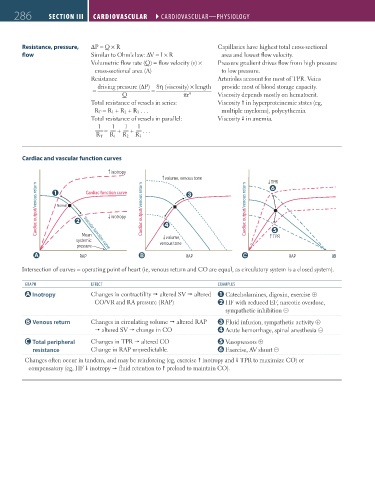
               Cardiac and vascular function curves

                                            inotropy
                                            ↓
                                                                  volume, venous tone               TPR
                                                                                                ↓
                                                             ↓
                   Cardiac output/venous return  Normal  ↓ inotropy  Cardiac output/venous return  Cardiac output/venous return
                                    Cardiac function curve


                                  Mean
                                                              ↓
                                systemic                          volume,                            TPR
                                                                                                 ↓
                                 pressure                   venous tone
                                   Vascular function curve
                   A              RAP                B              RAP                C              RAP
               Intersection of curves = operating point of heart (ie, venous return and CO are equal, as circulatory system is a closed system).

                GRAPH                EFFECT                                    EXAMPlES
                   Inotropy          Changes in contractility Ž altered SV Ž altered    Catecholamines, digoxin, exercise ⊕
                                       CO/VR and RA pressure (RAP)                 HF with reduced EF, narcotic overdose,
                                                                                 sympathetic inhibition ⊝
                   Venous return     Changes in circulating volume Ž altered RAP    Fluid infusion, sympathetic activity ⊕
                                       Ž altered SV Ž change in CO                Acute hemorrhage, spinal anesthesia ⊝
                    Total peripheral   Changes in TPR Ž altered CO                Vasopressors ⊕
                  resistance         Change in RAP unpredictable.                 Exercise, AV shunt ⊝
                Changes often occur in tandem, and may be reinforcing (eg, exercise  inotropy and  TPR to maximize CO) or
                 compensatory (eg, HF  inotropy Ž fluid retention to  preload to maintain CO).


          FAS1_2019_07-Cardio.indd   286                                                                                11/7/19   4:24 PM
   325   326   327   328   329   330   331   332   333   334   335