


Page 335 - First Aid for the USMLE Step 1 2020, Thirtieth edition [MedicalBooksVN.com]_Neat
P. 335
CARDIOvASCuLAR ``CARdIOvASCulAR—PHYSIOlOGY CARDIOvASCuLAR ``CARdIOvASCulAR—PHYSIOlOGY SECTION III 291
Heart murmurs
S1
Systolic S2
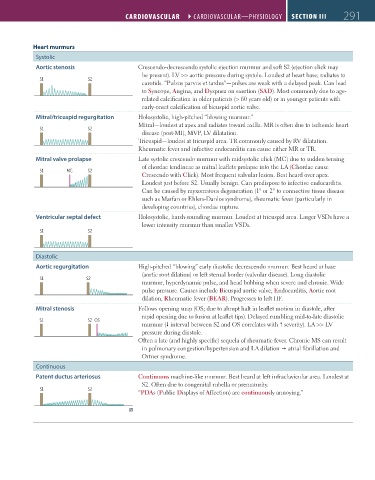
Aortic stenosis Crescendo-decrescendo systolic ejection murmur and soft S2 (ejection click may
be present). LV >> aortic pressure during systole. Loudest at heart base; radiates to
S1 S2
carotids. “Pulsus parvus et tardus”—pulses are weak with a delayed peak. Can lead
to Syncope, Angina, and Dyspnea on exertion (SAD). Most commonly due to age-
S1 S2
related calcification in older patients (> 60 years old) or in younger patients with
S1 S2
early-onset calcification of bicuspid aortic valve.
Mitral/tricuspid regurgitation Holosystolic, high-pitched “blowing murmur.”
S1 S2 Mitral—loudest at apex and radiates toward axilla. MR is often due to ischemic heart
S1 S1 MC S2 S2
disease (post-MI), MVP, LV dilatation.
Tricuspid—loudest at tricuspid area. TR commonly caused by RV dilatation.
S1 S2
Rheumatic fever and infective endocarditis can cause either MR or TR.
S2
S1 S2
S1
Mitral valve prolapse Late systolic crescendo murmur with midsystolic click (MC) due to sudden tensing
of chordae tendineae as mitral leaflets prolapse into the LA (Chordae cause
S1 MC S2 Crescendo with Click). Most frequent valvular lesion. Best heard over apex.
S1 S1 S2 S2
S2
S1 S1 S2 OS Loudest just before S2. Usually benign. Can predispose to infective endocarditis.
Can be caused by myxomatous degeneration (1° or 2° to connective tissue disease
S1 S2
S1 S2 such as Marfan or Ehlers-Danlos syndrome), rheumatic fever (particularly in
S1 MC S2 developing countries), chordae rupture.
S1
S2
S2 S2
S1 S1
Ventricular septal defect Holosystolic, harsh-sounding murmur. Loudest at tricuspid area. Larger VSDs have a
S1
S2
S1 S2 OS lower intensity murmur than smaller VSDs.
S1 S2
S1 S1 S2 S2
S1 S2
S1 S2
S1 S2
S1 MC S2
Diastolic MC S2 OS
S2
S1 S1
S1 S2
Aortic regurgitation S2 High-pitched “blowing” early diastolic decrescendo murmur. Best heard at base
MC
S1
(aortic root dilation) or left sternal border (valvular disease). Long diastolic
S1 S2
S2
S1
S1 S2 murmur, hyperdynamic pulse, and head bobbing when severe and chronic. Wide
S1 S2 pulse pressure. Causes include Bicuspid aortic valve, Endocarditis, Aortic root
S1 S2
dilation, Rheumatic fever (BEAR). Progresses to left HF.
S1 S2 OS
Mitral stenosis S2 OS Follows opening snap (OS; due to abrupt halt in leaflet motion in diastole, after
S1
S1 MC S2
rapid opening due to fusion at leaflet tips). Delayed rumbling mid-to-late diastolic
S1 S2 OS
murmur ( interval between S2 and OS correlates with severity). LA >> LV
S1 S2
S1 S2 pressure during diastole.
S1 S2 Often a late (and highly specific) sequela of rheumatic fever. Chronic MS can result
S1 S2
in pulmonary congestion/hypertension and LA dilation atrial fibrillation and
Ortner syndrome.
S1
Continuous S2 OS
Patent ductus arteriosus Continuous machine-like murmur. Best heard at left infraclavicular area. Loudest at
S2. Often due to congenital rubella or prematurity.
S1 S2
“PDAs (Public Displays of Affection) are continuously annoying.”
FAS1_2019_07-Cardio.indd 291 11/7/19 4:24 PM

