Page 336 - First Aid for the USMLE Step 1 2020, Thirtieth edition [MedicalBooksVN.com]_Neat
P. 336
292        SECTION III    CARDIOvASCuLAR  ``CARdIOvASCulAR—PHYSIOlOGY                                                                                          CARDIOvASCuLAR  ``CARdIOvASCulAR—PHYSIOlOGY


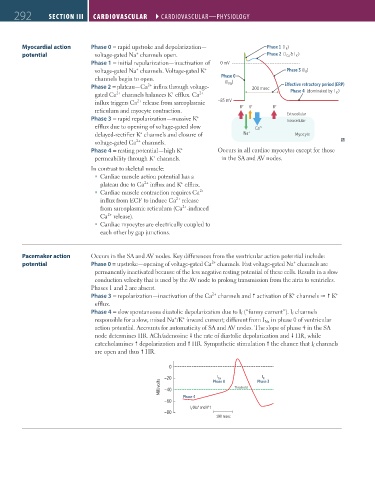
               Myocardial action     Phase 0 = rapid upstroke and depolarization—              Phase 1  (I )
                                                                                                     K
                                                    +
               potential               voltage-gated Na  channels open.                        Phase 2  (I Ca & I )
                                                                                                        K
                                     Phase 1 = initial repolarization—inactivation of   0 mV
                                                                          +
                                                    +
                                       voltage-gated Na  channels. Voltage-gated K                   Phase 3 (I )
                                                                                                           K
                                      channels begin to open.                   Phase 0
                                                                                  Na
                                                        2+
                                     Phase 2 = plateau—Ca  influx through voltage-  (I  )  200 msec  E ective refractory period (ERP)
                                              2+
                                                                                                                     K
                                                                +
                                      gated Ca  channels balances K  efflux. Ca 2+                    Phase 4  (dominated by I )
                                                    2+
                                       influx triggers Ca  release from sarcoplasmic   –85 mV  +  +  +
                                       reticulum and myocyte contraction.             K  K       K
                                                                        +
                                     Phase 3 = rapid repolarization—massive K                        Extracellular
                                                                                                     Intracellular
                                       efflux due to opening of voltage-gated slow         Ca 2+
                                                     +
                                       delayed-rectifier K  channels and closure of    Na +             Myocyte
                                                    2+
                                      voltage-gated Ca  channels.
                                                                  +
                                     Phase 4 = resting potential—high K        Occurs in all cardiac myocytes except for those
                                                          +
                                      permeability through K  channels.         in the SA and AV nodes.
                                     In contrast to skeletal muscle:
                                         ƒ Cardiac muscle action potential has a
                                                       2+
                                                                   +
                                        plateau due to Ca  influx and K  efflux.
                                         ƒ Cardiac muscle contraction requires Ca
                                                                         2+
                                                                 2+
                                        influx from ECF to induce Ca  release
                                                                   2+
                                        from sarcoplasmic reticulum (Ca -induced
                                           2+
                                        Ca  release).
                                         ƒ Cardiac myocytes are electrically coupled to
                                        each other by gap junctions.
               Pacemaker action      Occurs in the SA and AV nodes. Key differences from the ventricular action potential include:
                                                                                                       +
                                                                             2+
               potential             Phase 0 = upstroke—opening of voltage-gated Ca  channels. Fast voltage-gated Na  channels are
                                      permanently inactivated because of the less negative resting potential of these cells. Results in a slow
                                      conduction velocity that is used by the AV node to prolong transmission from the atria to ventricles.
                                     Phases 1 and 2 are absent.
                                                                                                                     +
                                                                                                       +
                                                                             2+
                                     Phase 3 = repolarization—inactivation of the Ca  channels and  activation of K  channels Ž  K
                                      efflux.
                                     Phase 4 = slow spontaneous diastolic depolarization due to I f  (“funny current”). I f  channels
                                                                 +
                                                                   +
                                       responsible for a slow, mixed Na /K  inward current; different from I Na  in phase 0 of ventricular
                                      action potential. Accounts for automaticity of SA and AV nodes. The slope of phase 4 in the SA
                                      node determines HR. ACh/adenosine  the rate of diastolic depolarization and  HR, while
                                      catecholamines  depolarization and  HR. Sympathetic stimulation  the chance that I f  channels
                                       are open and thus  HR.
                                                               0
                                                                              I
                                                                                             I
                                                             –20             Phase 0        Phase 3
                                                                               Ca
                                                                                             K
                                                            Millivolts  –40         Threshold
                                                                   Phase 4
                                                             –60
                                                                      I (Na and K ) +
                                                                        +

                                                                      f
                                                             –80
                                                                              100 msec


          FAS1_2019_07-Cardio.indd   292                                                                                11/7/19   4:24 PM
   331   332   333   334   335   336   337   338   339   340   341